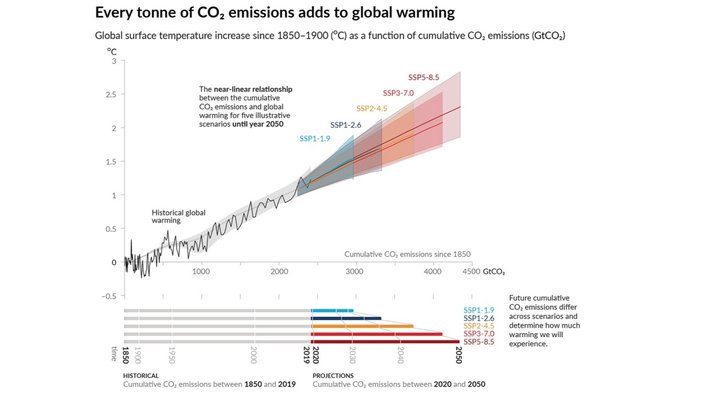
Fig.1: Illustration of assumption of a near-linear relationship between cumulative emissions & global warming. Source: IPCC AR6 WGI SPM Fig10, adapted
In my last post I walked through the reasons for concern about whether the current set of climate targets, based on the remaining carbon budget (RCB) are enough to keep long-term global warming below 1.5°C. Now I’d like to take a look at three key assumptions underpinning the RCB:
- All non-CO2 gases (methane, nitrous oxide as the prime ones) follow a declining path along with fossil-fuels.
- The linear relationship between cumulative carbon and temperature (the Transient Climate Response to Cumulative Carbon Emissions, TCRE – see plot above) holds also in the coming years/decades.
- Earth system feedbacks do not deviate beyond the stable conditions we have experienced over the past 10 000 years, i.e., climate sensitivity remains at around 3°C for a doubling of CO2 concentration (i.e., no shifts in Earth system resilience, and no tipping points are crossed).
Warming acceleration - observations
These are the basis upon which science provides us with a RCB of approximately 200 GtCO2 for a 50% chance of holding the 1.5°C limit. Without points 1-3 above being correct, the budget disappears. These are optimistic assumptions. Especially today, when we are experiencing what may be an acceleration of warming, with indicative trends showing a jump from 0.18 °C/decade from 1970-2014 (Hansen et al. 2023) to 0.27°C/decade for the 2014-2023 decade (Forster et al. 2024). Sea-surface temperature shows the same trend, with an abrupt shift in rate of warming over the past decade (Merchant, Allan, and Embury 2025). Added to this we have the record braking 1.6°C above the pre-industrial average for the year 2024, i.e., that we for the first time breach 1.5°C over 12 consecutive months.
https://climate.copernicus.eu/global-climate-highlights-2024
We know that we’ve just come out of a human-amplified (Cai et al. 2023) El-Nino, so couldn’t this all simply be a freak event on top of the steady (0.18°C/decade) warming we expect? With a high degree of certainty, the answer is no. The observations of a - off the charts - 0.3°C jump in the atmosphere and the ocean, cannot be explained only by a linearly reinforced El Nino. Something more is at play. This concern is further reinforced by the unexpected observation that January and February 2025 - which should have been a "cool" start of the year, as we have now entered a La Nina phase, were warmer than January 2024 (in the midst of the super El Nino). In fact, January 2025 is the warmest January ever recorded (1.75°C above pre-industrial temperature) and February was still anomalously high. This does not follow the standard climate script.
So, what is happening? The jury is still out, and many candidates have been brought forward.
Aerosol emissions
Helge Goessling (2024) and colleagues concluded that high solar cycle intensity, the 2022 sub-marine Hunga-Tonga volcanic eruption and new sulfur regulations on commercial shipping (reducing cooling sulfate aerosols), together only can explain 1/3 of the abrupt shift, i.e., 0.1°C. Jim Hansen et al. (2025) disagree, placing a 2/3 of the abrupt warming on the additional forcing caused by reduction in aerosol loading (air pollutants, in particular sulfates and nitrates, which act as reflective mirrors for incoming shortwave radiation, thus dimming the lower atmosphere). Here, I lean more towards the Goessling argument.
Importantly though, irrespective of the magnitude of the effect of aerosol loading, the reduction of these air pollutants would increase the overall climate forcing (removing, in Jim Hansen's language, the Faustian Bargain of us cancelling out GHG-driven heating with cooling from air pollution). Keep in mind that the avoided air pollution shortens the lives of 7-8 million people each year (btw, a rate of lives lost that is in the same order of magnitude as during the COVID pandemic).
Earth system feedbacks
Two (main) candidates remain. Both are Earth system feedbacks, i.e., factors that change the basic Earth response to human-caused forcing, making them factors that not only push us higher up along the linear TCRE line, but also shift the slope of the line. This would very likely translate to higher climate sensitivity - very bad news indeed!
These are:
- Earth albedo change. As shown by Goessling et al., Earth is getting darker and absorbing more heat, which is explained by a trend of a pronounced decline in low-level clouds in the Northern hemisphere, which decreases the reflectivity of incoming short-wave radiation. The northward shift of tree lines as the planet warms, and accelerated melting of snow and ice, also contribute to making the planet darker.
- Relative reduction in carbon uptake in the biosphere, particularly with signs of a weakening carbon sink in boreal (Virkkala et al. 2025), temperate (Burton et al. 2024) and tropical forests. The southeastern part of Earth's richest ecosystem on land, with a carbon stock exceeding 100 GtC, has already tipped over from sink to source (Gatti et al. 2021). Estimates show that the global land sink, which normally averages almost 10 GtCO2/yr (25% of global fossil-fuel emissions), reduced to less than 2 GtCO2 in 2023 (Ke et al. 2024). This fall off was caused primarily by droughts (over the Amazon) and fires, which are expected to increase during El Nino years (such as in 2023), but here we experienced an unexpectedly high loss of carbon uptake. The result is more carbon in the atmosphere - an Earth system feedback that increases climate forcing and accelerates warming. If this feedback persists, it would imply a higher climate sensitivity.
Earth losing resilience
The worry is this. Even though we do not know precisely which combination of these effects is ultimately responsible for the unexpectedly high global temperatures, we have received enough concerning signals from the Earth system, forcing us to seriously ask the question, are we seeing the first signs of Earth losing resilience?
That is, is its biophysical capacity to buffer the stress caused by Anthropogenic damage (i.e. excess fossil emissions) to the system eroding?
The most recent estimates already point to implications of a weaker planet showing first signs of accelerated warming. The 1.5°C limit will be breached earlier, probably already before 2030 (Cannon 2025).
Risk of crossing tipping points
And the BIG question out there is what does all this mean for the risk of crossing tipping points in the Earth system? We already have evidence that multiple tipping elements are likely to cross their thresholds when 1.5°C is breached permanently. This places us in a very delicate situation, given that these tipping elements (Tropical Coral Reef systems, the Greenland Ice Sheet, the West Antarctic Ice Sheet, abrupt thawing of permafrost, and collapse of the Barent sea ice) would not only affect billions of people, but comprise feedback systems, i.e., they can trigger permanent changes in the functioning of Earth, which would accelerate warming even further.
Again, the scientific jury is still out. But increasingly science shows (in addition to the 5 tipping elements already mentioned), that both the Amazon basin and the AMOC, are also at risk of crossing tipping earlier than previously thought, when factoring in all interacting drivers (e.g. for the Amazon: climate forcing + deforestation + biodiversity loss + shifts in hydrology; for the AMOC: slowdown of the thermohaline pump not only due to dilution from massive inflow of freshwater from melting of the Greenland Ice Sheet, but also from increased precipitation over the North Atlantic).
Climate sensitivity
These are all Earth system feedbacks, which impact on Earth's climate sensitivity. There has been a lot of discussion around the "holy grail" in climate science, the Equilibrium Climate Sensitivity (ECS) - how much warming is to be expected at equilibrium after a doubling of CO2. Since Jules Charney and the Charney report's first estimate in 1979 (3°C ± 1.5), the uncertainty around the ECS has remained stubbornly large, with a range of 1.5-4°C. There is some convergence around an average of 3°C (which is the ECS level that best reproduces observed global warming so far).
But 3°C is far from the end of the ECS story. Already in 2008 Jim Hansen concluded that while ECS due to fast feedbacks may be 3°C, the real ECS when factoring in slow feedbacks, like albedo shifts and changes in the cryosphere and ocean heat balance, is more likely 6°C. Several GCMs in the CMIP6 round showed ECS levels > 4°C, mostly as a result of more detailed representation of cloud dynamics (i.e., that better understanding of cloud feedbacks results in amplified warming due to changes in Earth's albedo, confirmed by the Goessling et al. (2024) work). Importantly, none of these high-ECS simulations include tipping points, only corrections in slow-shifting changes related to, for example, cloud dynamics and thawing permafrost.
So, in summary, while this series focused on the fact that even the most ambitious climate action is far from aligned with science (i.e., will fail on 1.5°C), this post describes how the Earth system is telling us that the remaining carbon budget is in fact even smaller. Our Earth may be losing resilience. We are seeing signs of accelerated warming over the last decade and abrupt deviations from predicted trends in the last years, which may suggest an Earth system shift in climate sensitivity. Higher climate sensitivity would mean a lower remaining carbon budget, and would erase any chance of an orderly phase out of fossil-fuels and a safe landing for humanity on a planet that can continue to provide decent life for all humans in the world.
In the next post (Part 3), I will address what all this means for our efforts of securing life support for humans on Earth.
https://app.wedonthavetime.org/posts/4b4d58d7-9313-4890-8a94-859a7fd0bddb