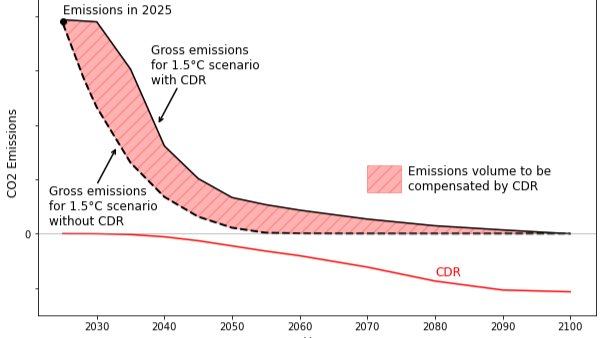
Fig1: Emissions pathways with same carbon budget. Solid lines show gross emissions (black) & removals via CDR & land use. Source: J. Rockström
In this series of posts, I’d like to give you my take on where science stands on Earth system risk, action to avert climate change and the path forward.
1.5°C physical limit not target
Science is increasingly clear that a 1.5°C departure away from the Holocene average global mean surface temperature (GMST) on Earth of 14°C is a physical limit. It is not a goal or a target, as it is often treated in policy, media and general debates. Go beyond 1.5°C warming, a place our civilisations have never experienced and Earth has not seen in the last 100,000 years, and we will not only see major human and economic damage, but are likely to cross multiple Earth system tipping points, causing amplified warming with billions of people affected (Armstrong McKay et al. 2022).
https://www.nature.com/articles/s41558-025-02247-8
This calls for a probing safety check. Are our targets for staying within the 1.5°C guardrail really enough? Or are we cheating ourselves, when we think that if all countries and companies join the “best in class” by following the carbon law (i.e. cutting emissions by half each decade, Rockström et al. 2017), we will have a reasonable chance of a “safe landing”? This is the conviction that guides both the voluntary climate action efforts (e.g. the over 7000 companies with science-based targets as part of the Science Based Targets initiative SBTi) and the European Green Deal and its "Fit-for-55" policy (stipulating emissions cuts in the EU of 55% by 2030), and one that, admittedly, I was deeply involved in crafting. But today, we have several reasons to question if these science-based targets are enough.
Let me briefly walk through the reasons for concern, putting into question even our (current) best climate efforts. As I go along, keep in mind that, globally, we are depressingly far from following even the carbon law, which would require going from increasing global emissions by around 1% per year (as we do today) to immediately starting to reduce fossil-fuel emissions by some 5% per year.
Remaining carbon budget and what is tolerable risk?
The first reason for concern is, of course, that we have largely consumed our entire global carbon budget. The remaining carbon budget (RCB) is the total amount of future carbon dioxide emissions that can stay in the atmosphere without crossing a prescribed global warming guardrail (e.g. 1.5°C). The size of the budget also depends on the level of confidence you want to have that you won’t transgress the guardrail: higher confidence, lower RCB and vice versa.
The RCB was estimated by the IPCC in the most recent assessment in 2021 (AR6) at approximately 500 GtCO2 (for a 50% chance of holding the 1.5°C limit). But we have since continued to "eat up" approximately 40 GtCO2 per year, and, combined with some additional updates and adjustments, are now down to around 200 GtCO2 as of the beginning of 2025 (estimates range from 160GtCO2 up to 310GtCO2; Friedlingstein et al. 2024).
But, if we take the risks of crossing 1.5°C seriously, then the question is the following: are we really taking responsibility for the future of our children and all future generations on Earth by "tossing a coin" (50% chance of success)? My answer is no. Even a 67% chance gives an uncomfortably high likelihood of failure. But OK, let’s aim for the slightly loaded dice in our favor. What does this give us in terms of RCB? Something around 150 GtCO2. At the current rate of emissions, this will be exhausted within 4 years!
If we take these numbers seriously, which we should, it translates into a completely different speed of transition than what we are generally talking about. Staying within a 150 GtCO2 budget (for a 67% chance of success) would require removing around 6 GtCO2 per year (~15% of today's total emissions) to reach zero emissions just after 2030. This is obviously completely unrealistic - even if we decide to shut down the global economy "à la COVID pandemic", which temporarily, and for the wrong reasons, cut global emissions by 6-7%.
So, what are world leaders banking on?
CDR assumptions allow for higher gross emissions
The way science and policy have handled this conundrum so far is to assume/hope that carbon dioxide removal technologies (CDR) will help us to an "orderly" transition towards a safe landing around 1.5°C, rather than a global crash landing at a much higher temperature.
You can think of the RCB as a bucket being filled with greenhouse gas emissions. Once the bucket is full, the RCB is exhausted. If, however, there is some way of getting rid of the emissions through a valve at the bottom of the bucket, say using carbon dioxide removal (CDR), the bucket will fill more slowly and the total amount of emissions used to fill the bucket (gross emissions) will be higher than the volume of the bucket itself (net emissions).
Here we stumble across one of the confusing (and disturbing) points in the climate debate. The carbon budget is generally used to describe the net remaining fossil-fuel emissions of CO2 (including CO2 emissions from agriculture). On the other hand, the policy targets and decisions on the pace of emission reduction (i.e., the entire mitigation policy agenda) allow for almost twice as much gross emissions as the budget allows, because they assume that CDR will do much of the heavy lifting by drawing down massive amounts of carbon from the atmosphere. In other words, the world's most ambitious emissions reductions targets (prescribing fast, but still far-from-sufficient reductions) correspond to gross emissions that would blow the budget, if it weren’t for the assumed removal of greenhouse gases from the atmosphere.
Take a look at the two 1.5°C-compatible gross emissions scenarios in Figure1 above: one relies on CDR (the solid line) and the other does not (dashed). Both scenarios lead to the same overall carbon budget, but the gross emissions in the scenario that relies on CDR are considerably higher than in the scenario without CDR (the difference is shown by the area between the dashed and solid lines) – a difference assumed to be compensated for by substantial removals through CDR and in land systems (see the red curve). It is immediately clear how much more rapidly emissions need to be reduced if CDR is employed.
So, if you assume a lot of CDR technologies (DAC, CCS, BECCS) and believe in a rapid agricultural transformation, you can stay within the carbon budget while tolerating relatively high gross fossil fuel emissions. This is the status quo and it means that gross emissions reductions targets alone (without CDR) do not align with the RCB. Even if we are able to achieve the current gross emissions reductions targets, failing on CDR will leave us blank.
The remaining carbon budget should instead be seen as a credit, with CDR and negative emissions from agriculture offering a second line of credit amounting to hundreds of GtCO2 according to middle-of-the-road scenarios. So, betting on CDR gives us an imaginary path towards a safe and orderly landing. The combined credit can more than double the allowed emissions for a 50% chance of holding 1.5°C, letting us believe that removing around 3 GtCO2 or 7.5% of current emissions from the global economy per year (UNEP Gap Report 2024) will be enough.
Feasibility of CDR assumptions
But is it realistic that we actually receive the second credit? Can global agriculture abruptly transition from the world’s single largest emitting economic sector in society, to become a major carbon sink, in less than 10 years? Is it really possible to scale CDR from millions of tons of pilot schemes today to billion tons of removals within years? So far, it looks like a long shot. However, the above quick walk-through of the numbers shows one thing beyond any doubt: whether we like it or not, we have burned such a large share of the RCB, and at the same time have so much evidence that we need to do everything we can to hold on to 1.5°C as a hard limit, that we have no choice but to massively scale up CDR and shift agriculture from source to sink, together with dramatically accelerating the phase out of fossil-fuel emissions (at a rate of more than 7.5% per year, following the 2024 UNEP Gap Report on required gross emission reductions, i.e., factoring in assumptions that CDR is scaled).
In my next post I’m going to look at the other very important assumptions on which the RCB hinges, and what the Earth might be telling us about the validity of these assumptions.
Read next part of this series:
https://app.wedonthavetime.org/posts/58cf0583-2644-4b83-b754-b7a0b6893f1b