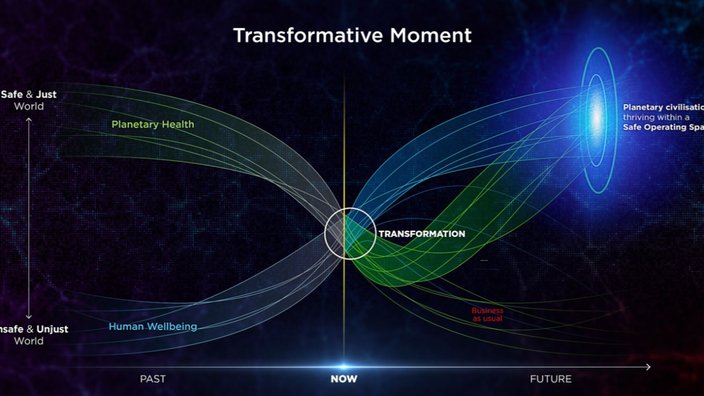
Fig1: Based on Bennett et al. (2016).
In the previous two posts in this series, I addressed two issues:
- We are confronted with the dilemma that even our best climate efforts are insufficient to have any chance of holding the 1.5°C global warming limit.
https://app.wedonthavetime.org/posts/7decc652-f90c-4e1b-b851-cddbe637bc19
- There is deep scientific worry that Earth may be losing resilience, resulting in feedbacks that not only would continue to "bump up" warming, but also reduce the capacity of the planet to buffer human abuse to the system (i.e., leading to a shift in climate sensitivity, and thus reduce even further the remaining carbon budget for an orderly transition to a safe operating space on Earth).
https://app.wedonthavetime.org/posts/58cf0583-2644-4b83-b754-b7a0b6893f1b
In this final post, I'd like to share a few thoughts on what all this implies for our actions now and in the coming years. In my view, the current scientific diagnosis of the state of the planet leads to two main conclusions:
- We cannot exclude that Earth is losing resilience, which will manifest in higher Earth climate sensitivity (ECS). This does not mean that current estimates of ECS for the past are wrong, but rather that when multiple planetary boundaries are breached simultaneously - weakening the buffering capacity of the biosphere, ocean, and cryosphere - Earth may shift into a regime with a higher ECS. The fact that we are in unchartered waters - paleo-climatically and geophysically - matters. We are currently witnessing an Earth Energy Imbalance (accumulating more heat on Earth than is reflected back to space) on a planet that, already at the starting point, is in a warm, inter-glacial equilibrium (Holocene). Put another way, we are shifting from a warm (natural) state, to an even warmer trajectory, forcing Earth to move from a warm equilibrium to even warmer conditions. The glacial-interglacial cycles of the past one million years don’t offer a play book for such a shift: it is outside of the Pleistocene logic.
- We have an unfortunate convergence of facts: (1) running out of carbon budget; (2) 1.5°C is a limit, not a goal to negotiate with; and (3) a weaker planet means lower capacity to buffer human caused warming, which results in an even smaller remaining carbon budget. The only responsible action to 1+2+3 is, in my view, to take the planetary crisis seriously, and do everything we can to deviate away from the danger that is hitting us faster than we had expected.
In the UNFCCC, all countries in the world have agreed to avoid dangerous climate change. Well, we are now in the midst of danger. Already in the coming years and decades we can expect unmanageable outcomes, if we do not radically shift course, now.
The path to a solution is quite straight forward:
- Implement the Dubai agreement (signed by all countries) to accelerate the transition away from fossil-fuels this decade. Step one is to remove 3-4 GtCO2 from the global economy in 2025. This would be the necessary start on a journey to cut-global emissions by 50% by 2030. Still insufficient, but will very likely lead to self-acceleration of the transformation away from oil, coal and gas.
- Put an end-date on all fossil-fuel driven transport (as it has been done in the EU - stopping the sales of combustion engine cars by 2035).
- A global decision to forbid all investments in new oil, gas and coal extraction and utilities.
- Introduce a global price on carbon of 100-200 USD/ton (constrained and rising) for all sectors.
- Halt the expansion of agriculture into the remaining natural forests and other land-based ecosystems (approximately 50% of Earth's land surface).
- Legally declare the ocean (its biology, sea-floor, and heat-conveyor belt) and all tipping point systems as global commons, and compensate tipping point hosting countries for their service to humanity (if they preserve them). Start at COP30 with the Amazon.