Climate success is often thought of as a straight swap of one energy system for another. No transition in history has been so linear. Real-world transitions are pluralistic, uneven, geographically fragmented, and full of friction.
When we evaluate complex systems against an impossibly pure benchmark, genuine momentum becomes insufficient and ordinary trade-offs are seen as defeat. Worse still, our primary scoreboard is measuring the wrong unit. It’s easy to focus on regional or national emission targets when planning new energy developments, rather than tracking how the energy system behaves as a whole. The way you calculate it can make a big difference—Switzerland’s domestic energy generation is one of the cleanest in Europe at 29 grams of CO2e per kilowatt-hour, but when imports are counted, the figure nearly doubles to 50 grams, and on winter evenings it climbs past 90, more than three times the domestic figure. The result is a strange paradox: the movement is often much further along than it believes in a real sense, yet blind to the setbacks that don’t show up on the balance sheets.
Maintaining the Baseline
An example of both sides of this story can be found in Sweden. When roughly 1,700 MW of nuclear capacity was phased out at Ringhals in southern Sweden, it was successfully replaced by rapid wind expansion, maintaining the country’s clean output—161.6 TWh after the phaseout in 2024 compared to 157.9 TWh of national output before the phaseout in 2015.
While this proves that clean power can genuinely replace clean power at a macro level, the scoreboard doesn’t take into account where the power is generated, and where it is used. In southern price zones like Malmö, electricity prices jumped by up to 141% and price volatility rose by up to 520%, much higher than the rest of the country. For “Malmöites”, the Swedish term for citizens of Malmö city, this felt like an injustice as they faced unpredictably high energy prices while national energy supply was not an issue. A similar strategy was applied when Switzerland’s baseload capacity went offline during the scheduled maintenance at Leibstadt in 2021 and Gösgen in 2025. Through a combination of nuclear and hydro power, Switzerland has maintained one of the cleanest energy grids in Europe. While the nuclear capacity was offline, hydropower was slated to fill in the gaps in baseload power. However, an analysis by the Anthropocene Institute shows that while the immediate energy needs were covered by hydropower, the lost energy wasn’t replaced, it was only borrowed. 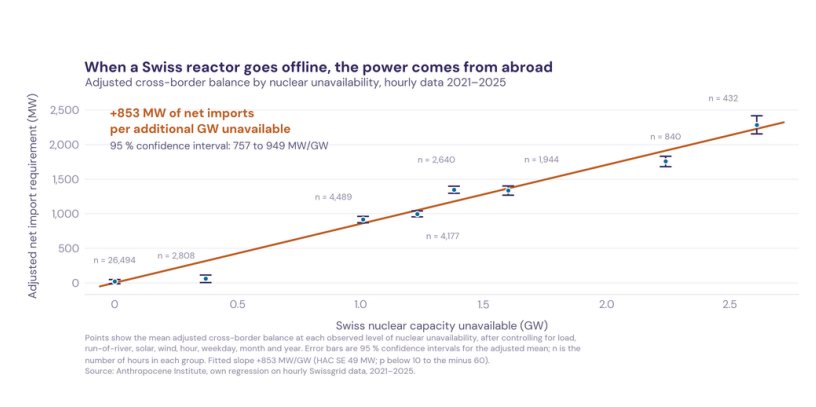
A clean power grid must be resilient enough that when one power source goes offline, it isn’t reliant on imported fossil fuels to maintain capacity
Hydropower covered part of the gap at first, but it was only borrowed. The water had to be paid back in the months that followed. The real replacement, about 4.6–4.8 TWh per outage, came from neighboring grids in Germany, France, Italy and Austria, mostly gas-fired. Switzerland’s clean generation held up on paper, while the fossil generation happened next door.
These aren’t examples of energy transition failures. On the contrary, Sweden and Switzerland are both examples of countries where climate progress has come further than public perception may indicate, but national energy assessments hide where real improvements can be made. To achieve a fully decarbonized energy system, the systems need grid capacity and resilience—which won’t show up in domestic accounts of carbon intensity.
The Danger of Monocultures
This need for resilience becomes even more clear when power plants are disrupted by increasingly frequent extreme weather events.
Following the driest spring since records began in 1864, Swiss hydropower reservoir storage plummeted to 46% capacity in summer 2026—a 20-year low. Overall hydropower output fell 18% to 25% below historical averages, with run-of-river plants dropping up to 30%. Yet media coverage that summer focused almost exclusively on river-cooled thermal plants that had to throttle due to warm water, largely overlooking the far larger systemic deficit in hydropower.
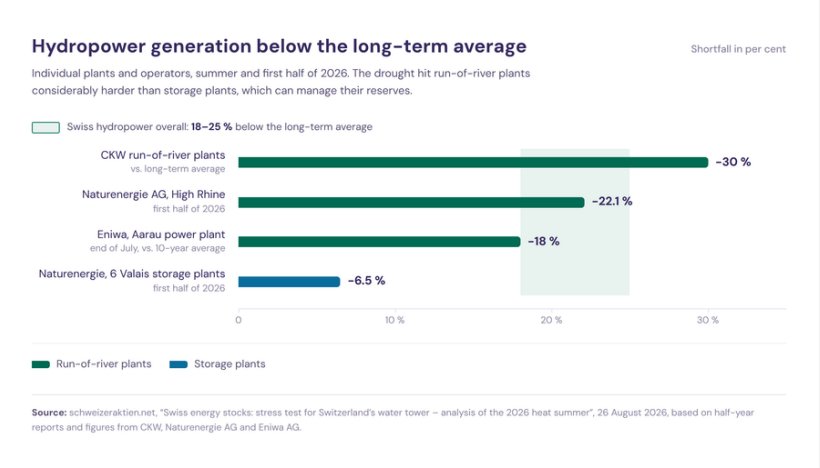
Hydropower was the energy source most vulnerable to the 2026 drought in Switzerland, but the media landscape overlooked this vulnerability in the power system.
The lesson is not that wind or hydro are inadequate—both are indispensable pillars of decarbonization. Rather, the lesson is that energy monocultures of any stripe are inherently fragile. Just as over-relying on a single weather-dependent source introduces volatility, leaning excessively on a handful of massive thermal assets can leave a grid exposed when a large reactor goes offline unexpectedly, as Finland has seen.
Redefining the Scoreboard
Real decarbonization is not an ideological purity test; it is an engineering challenge that requires complementary tools. Renewables, firm zero-carbon baseload, interconnections, long-duration storage, and demand response are not competing camps. They are interconnected components of a synchronized machine.
As countries introduce fossil fuel phase-out roadmaps, as seen by France, Germany, the Netherlands, and Tuvalu earlier this year, proper measurement is the first step to achieving this. A modern climate scoreboard must move past territorial generation badges. It needs to measure:
- Hourly consumption intensity: Tracking where power originates in real time rather than papering over emissions with cross-border imports.
- Systemic resilience: How portfolios endure climate-driven heat waves, droughts, and seasonal shortages.
- Total system cost and stability: Ensuring clean power is delivered reliably to local demand centers, avoiding the economic volatility that erodes public support.
The fastest available climate gain does not require waiting for an undiscovered technology. It requires fixing the way we measure success. When we measure energy networks as they function in the physical world, we stop interpreting necessary real-world trade-offs as defeat, and finally equip ourselves to back what actually works. A clean scoreboard is not the same as a clean system.