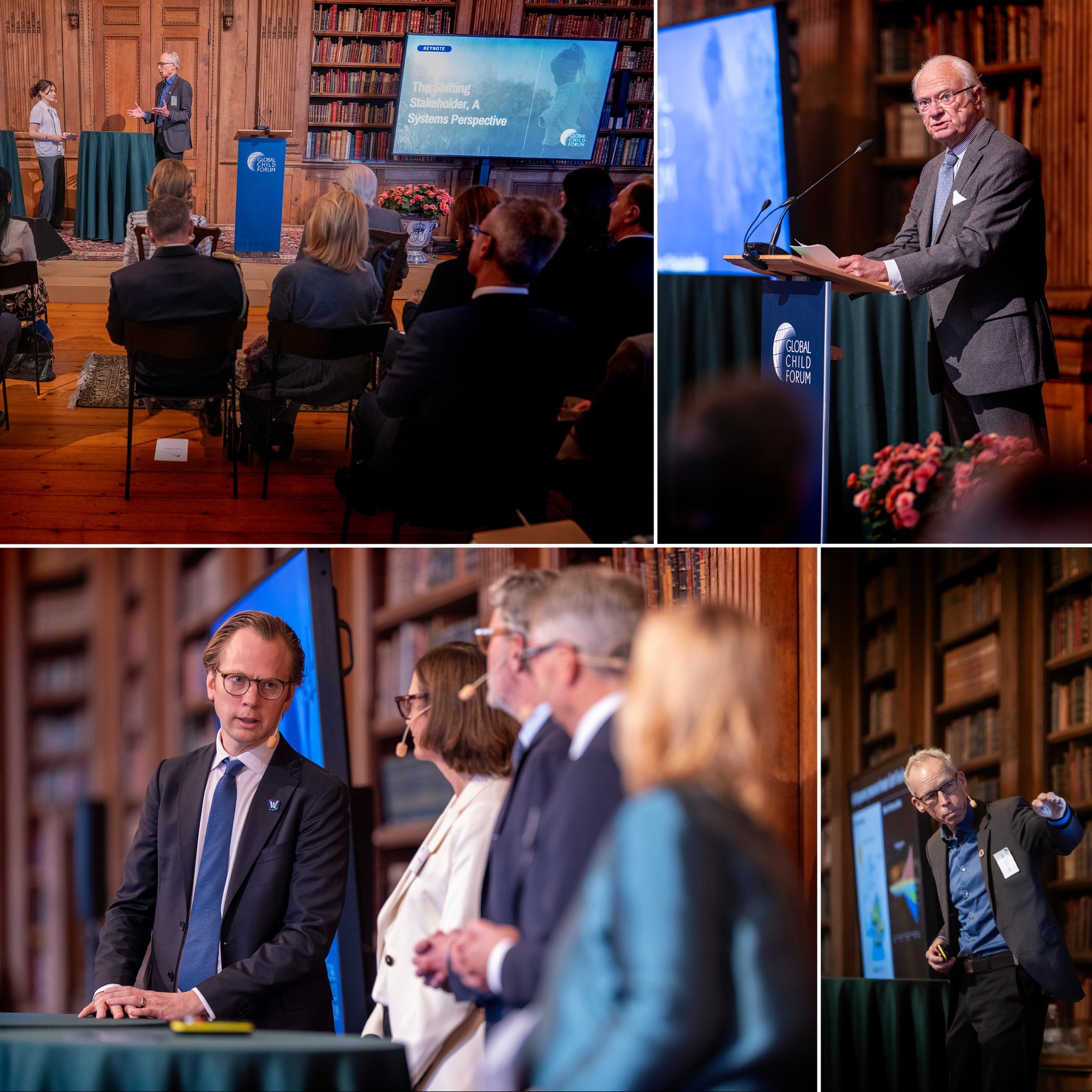
What I told business and investment leaders at Global Child Forum, and the encounter with the King and Queen that stayed with me.
“If your clients want to invest in oil, you should not let them invest in oil. Don’t give them the choice.”
That is what I said during our panel on investing in the next generation at Global Child Forum, at the Royal Palace in Stockholm.
It was a direct challenge to the financial sector. I know that.
But we had spent the morning talking about children’s futures and listening to the science, and I felt that responsibility had to reach the decisions being made by the people in that room. By then I was also carrying a conversation from earlier in the day, with a mother the Queen had asked me to meet.
I will come to that. First, the question the King asked us.
Keeping one child in mind
Global Child Forum was initiated in 2009 by King Carl XVI Gustaf and Queen Silvia of Sweden to advance children’s rights in the business world. This year it brought CEOs, chairs and senior investors to the Royal Palace to consider how children can be recognised as stakeholders in corporate decisions. https://www.kungahuset.se/english/archive/speeches/2026-10-14-hm-the-kings-welcome-speech-at--global-child-forum
At the opening, His Majesty the King asked each of us to keep one child in mind throughout the day. Our own child or grandchild. A young person we knew. Perhaps the child we once were. When facing a difficult decision, would we feel comfortable explaining our choice to that child?
I first thought of my daughter, my firstborn.
That was no coincidence. Her birth was the moment I started to engage in the climate issue. The future stopped being an abstraction and became someone I held in my arms. She is the reason I began working for it, and I have not stopped since.
But by the time I sat down on the panel, I was also thinking of another child, and of a mother I had just met.
An unexpected invitation from the Queen
During a break, a member of the Queen’s staff came over and told me that Her Majesty had asked to see me. I had not expected that.
The Queen wanted to introduce me to a mother whose son, Isaac, had died eight months earlier, at 15. A criminal investigation and a coroner’s investigation are still ongoing, and the family are still searching for answers about what happened to him. His Majesty the King was there as well.
Earlier that day, we had been reminded that our children’s digital lives are a critical part of their real lives. This mother has met barrier after barrier trying to get any clarity about why her son died.
She told me that handset manufacturers refuse to release PIN codes or unlock a phone after a child has died, even when the child was a minor and the contract is in the parent’s name. Social media platforms do not engage and do not share the data they hold. Instead they raise obstacles and legal challenges that cost families time and money and keep vital information from reaching police and coroners, whose own processes were not built for the digital world our children live in.
Meanwhile, the perpetrators of digital crimes that may have driven a child’s death carry on with their lives. Often they are still active on the very platforms they used to devastate a family. Sometimes they are still mocking the child who died.
And this family is not alone. Other families who have endured similar tragedies are slowly finding each other, and their stories are strikingly similar. There are far more of them than any of us realise.
Her son Isaac was dead. Standing there together, each of us realised it could have been our own child.
How can companies claim to take children’s safety seriously while refusing to cooperate with the authorities and letting this go on?
That the Queen chose to bring us together says a great deal. Standing there with the King and Queen, listening to this mother, I saw how personal this work is for them. The King’s opening question had become painfully concrete.
I carried her story onto the panel. I am grateful to her for trusting us with it.
Children’s futures cannot depend on investment trends
On the panel, the conversation turned to how investors’ interests shift. Sustainability had drawn attention for a while; then other sectors and priorities took over. Could investing in the next generation become just another trend?
My answer was simple: do the right thing, whatever the trend. Investing in our children’s future is a responsibility, and a responsibility should survive a change in market sentiment.
Money can go in two directions. It can build the fossil-free society we need, and we need much more of that. Or it can fund new fossil fuel extraction and the companies that spend their money lobbying against the rules that would protect our children. The second kind of investment can undo the progress we make with the first.
A bank chooses whom it lends to. A pension fund chooses what it owns. And all of us, as customers, choose the bank, the fund and the institution. As I said on the panel, we vote with those decisions, every day, whether we think about it or not.
That brought me to the simplest message I wanted to leave with the room:
“Every time you invest a dollar, think of a child.”
The moderator picked up on that line, and the discussion turned to whether funds could be built around children’s futures. I welcomed that, but I felt we needed to go further.
“It’s not happening”
Others on the panel raised financial education, family-friendly working conditions, and greater awareness of children’s rights among portfolio managers. All of that matters. But when we came back to responsibility, I had to point to the gap between our intentions and what is actually happening.
“It’s not happening,” I said.
Over the past twelve months, we have documented 45 climate policy rollbacks at We Don’t Have Time. At a time when we need stronger protection, governments are weakening the protection we already have. We had heard Johan Rockström’s warning that morning. We understood the stakes. The direction of travel was still wrong.
That was why I challenged the idea that investment decisions should simply follow what clients want.
“It’s not a choice that you listen to your clients. It’s a responsibility. If your clients want to invest in oil, you should not let them invest in oil. Don’t give them the choice.”
To be precise: I am not asking banks to walk away overnight from every company that produces oil. I am asking them to stop financing new extraction, meaning exploration, new fields and expanded production, and to stop financing companies that lobby against climate rules. Existing production can be financed while it winds down. Expanding the problem, and funding the campaign to keep it going, cannot.
I know the objection. It is the client’s money, and a bank that says no will lose the client to a bank that says yes.
But many banks and pension funds already say no to something. Tobacco, cluster munitions and thermal coal sit on exclusion lists across much of the financial sector, and few people call that paternalism. They call it policy. The principle is settled. The only open question is whether new oil and gas extraction belongs on the list.
The children who will live with the consequences get no say in those investments. The adults making them do.
“We can’t fix the future if we are not acting in a very different way,” I said. I believe that. Fund the movement for change
Good examples show what is possible. I have spent much of the past decade amplifying them through We Don’t Have Time. But we also face powerful interests working to stop change, and good examples alone do not overcome organised resistance.
A deeply harmful system does not end because a few influential people decide, one by one, to behave differently. It ends when organised movements change the rules. People with wealth and influence can help make those movements possible. So I asked for more than responsible investment in individual businesses:
“We need rich, influential people funding the movement for change so that our future, our kids have a future.”
The obstacle is not money. Worldwide, clean energy already attracts roughly twice the investment that fossil fuels do. The obstacle is the political resistance behind those 45 rollbacks, and that is what a movement is for.
Finance can build solutions. It can also fund the public and political effort needed to make those solutions win. There were people in that room with the ability to do both.
“I think we can do that.”
Communication is part of the solution
This also connects to my own work. Alongside We Don’t Have Time, I co-founded W Social.
https://wsocial.eu
On the panel, I connected both to the challenge Johan had put in front of us. Sharing good examples is not enough when powerful interests can shape what we are allowed to talk about. We need free communication platforms with clear rules and with respect for children and future generations. That is one of the reasons I am building W.
Isaac’s story is why the second half of that sentence is not a slogan. Platforms affect real lives. Their decisions about safety, accountability and cooperation with the authorities can have devastating consequences for a family. The freedom to communicate and the responsibility to protect people belong in the same conversation about our future.
The question I took home
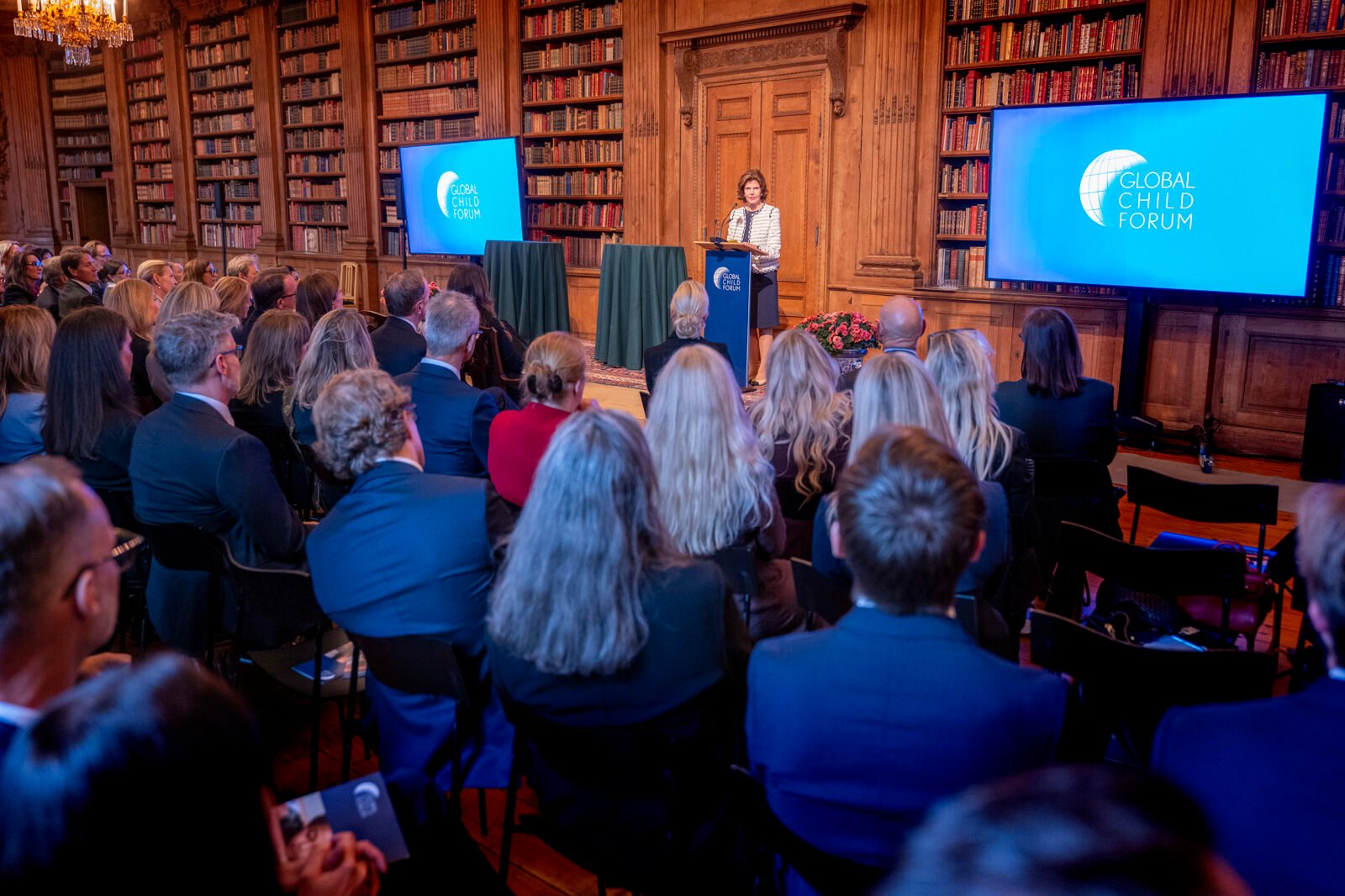
Her Majesty Queen Silvia of Sweden delivers the closing keynote at Global Child Forum, held at Stockholm’s Royal Palace on 13 October 2026. Photo credit: Jonas Borg, Global Child Forum
I did not know how my remarks would be received. Afterwards, more people came up to me than after any panel I can remember, and many thanked me for being direct. Not everyone agreed, I am sure. But it gave me hope that there is room for a more honest conversation about responsibility among people with the power to move a great deal of money.
I am grateful to Global Child Forum for creating that space, to my fellow panellists, and to the King and Queen for bringing children’s lives so personally into the room.
At the close of the day, the Queen spoke about a boy she had once met in Brazil, living in a cardboard box. She had never forgotten him. She asked what we would do differently because of the child we had kept in mind.
https://www.kungahuset.se/english/archive/speeches/2026-10-14-hm-the-queens-closing-speech-at--global-child-forum
I left thinking about that question. About my own children, and the daughter who started all this. About the mother Their Majesties had introduced me to, and Isaac, the son she had lost.
And about the decisions we make with our money.
Every time we invest, we help shape the world a child will inherit. We should be able to look that child in the eye and explain why.
If you want to help Isaac’s family, their team of 70 fundraisers is running the London Marathon in 2027 to raise awareness of these challenges for children and drive the change needed to address them. You can also follow the campaign here. https://www.justgiving.com/campaign/the-isaac-marathon