⚠️ The Fossil Lobby Is Winning: 45 Climate Policy Reversals in One Year

Ingmar Rentzhog
11 w
•
•
Last week I wrote on LinkedIn: I have been following climate politics for a long time. I do not think I have ever felt this upset. As the climate crisis accelerates, our leaders are not accelerating climate action. They are reversing it.
The post resonated far beyond what I expected. And the most common response was a question: is it really that widespread, or does it just feel that way? This article is the answer. I spent the days since verifying every reversal I could find, decision by decision, source by source. It is worse than I wrote.
Because this was the summer the bill arrived. Three heatwaves hit western Europe in three months, including England's hottest June since records began in 1884. The June heatwave alone wiped around 10 million tonnes, worth roughly 2 billion euros, from European grain forecasts; after improved prospects in a few less affected countries, the net reduction was about 9 million tonnes, approximately 1.8 billion euros, with France accounting for 3.4 million tonnes of reduced maize after extreme heat struck during critical stages of crop development. In the UK, the same week cost the economy 1.15 billion pounds in 24 million lost working hours, and one think tank puts the productivity hit at least 2.4 billion pounds. The climate crisis is no longer a future cost. It is hitting farmers, workers, businesses and families now.
In the comments, someone asked a fair question: have we not known for a long time that things are going wrong? Yes. But there is an important difference. Before, climate policy was far too weak and far too slow, but at least the overall direction was forward. Now, as the consequences become impossible to ignore, the political response is increasingly to weaken even the limited policies already in place. Climate policy is no longer just moving too slowly or getting stuck. In crucial areas, it is moving backwards. That is a profound difference. And honestly, it scares me.
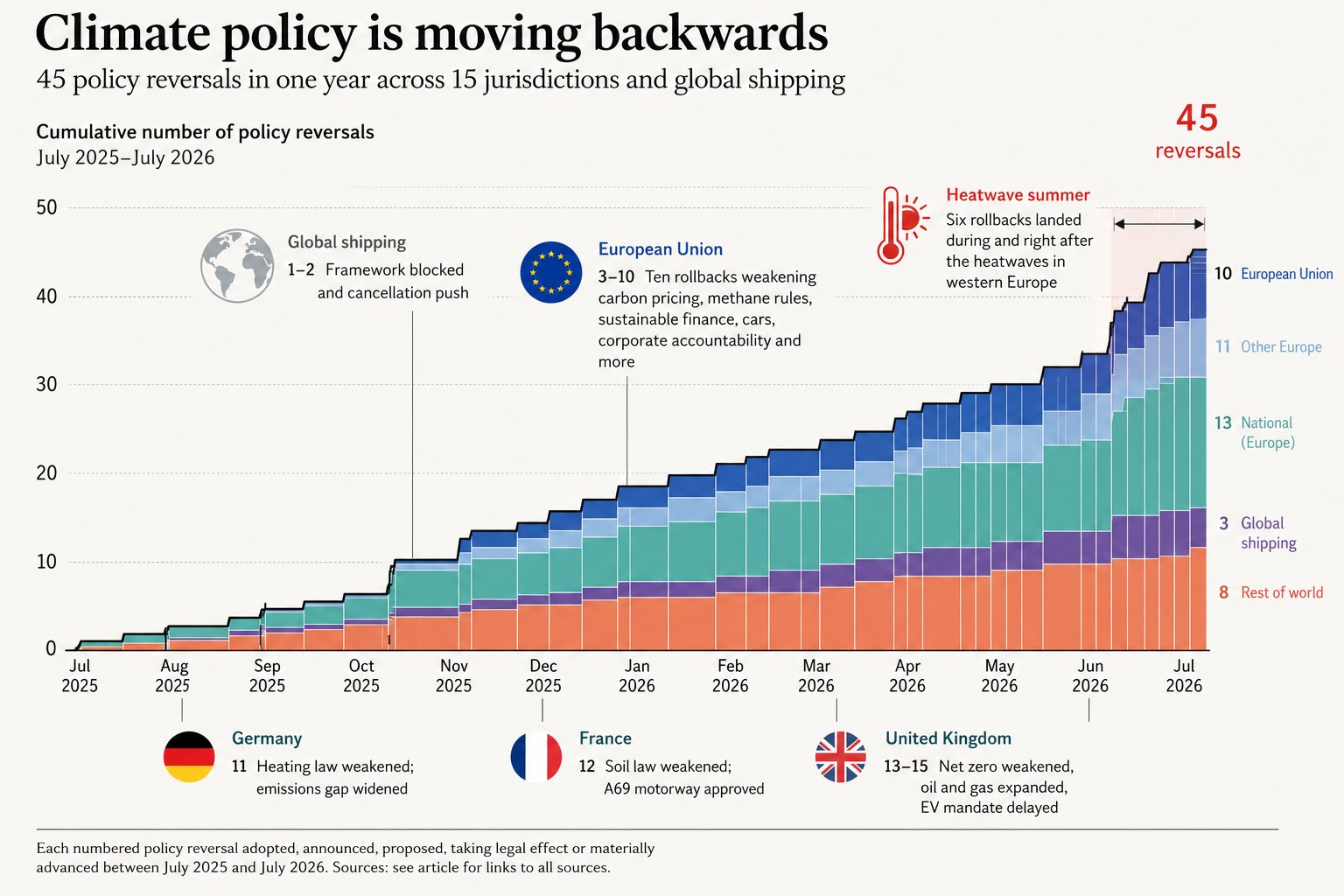
So here is the verified count: 45 policy reversals in one year, numbered below, across 15 jurisdictions and the global shipping regime. Each numbered entry is one distinct policy reversal adopted, announced, proposed, taking legal effect or materially advanced between July 2025 and July 2026, and its status is stated in the entry. Six landed within five weeks this summer, during and right after the heatwave itself. These decisions were not made in ignorance of the costs. They were made in the middle of them.
Across much of the list, the lobbying and organised pressure are documented on the record: fossil fuel producers, automakers, agribusiness, and fossil producer states pressuring foreign regulators with threats of tariffs and redirected energy supplies. Every claim below links to its source. Because history will not ask whether we had enough evidence. It will ask who lobbied, who decided, and who benefited.
🌍 Global shipping
1. Framework blocked (October 2025). The IMO adjourned a full year without adopting the Net-Zero Framework after the US pressured smaller states with tariff, port fee and visa threats, alongside Saudi Arabia.
2. Cancellation push (March 2026). Washington then asked for the framework to be cancelled outright.
🇪🇺 European Union
3. Carbon market (proposed, 17 July 2026). The Commission proposed weakening the the main ETS, the carbon market covering industry and power more than analysts expected, putting roughly 2.4 billion extra tonnes of CO2 at stake, after an EPP demand paper and pressure from Poland and Italy.
4. Methane (guidance, 20 July 2026). The Commission recommended suspending import penalties for 2027 to 2029, after the US, Qatar, Algeria and Nigeria wrote to Brussels and 17 member states demanded changes.
5. Sustainable finance (Council position, 24 June 2026). Member states deleted the ban on "transition" funds financing new fossil fuel projects. TotalEnergies had held about 35 meetings with MEPs in the months before.
6. Cars (proposed, December 2025). The Commission proposed dropping the 2035 combustion engine ban, cutting the target from 100 to 90 percent, after lobbying from Germany, Italy and their auto industry. Still in negotiation.
7. 2040 target (Parliament adopted 10 February; final Council approval 5 March 2026). The climate law allows up to 5 percent international offsets, so domestic cuts stop at 85 percent. Poland had pushed for 10 percent.
8. ETS2, the separate new carbon market (adopted, same law). The carbon price on heating and transport fuels was postponed a year to 2028, a demand won by Poland and eastern member states.
9. Corporate accountability (final approval 24 February 2026, applying in stages). The Omnibus package slashed sustainability reporting, weakened due diligence and removed the climate transition plan requirement. Investigations show eleven multinationals coordinated to derail the law and ExxonMobil was the most active corporate lobbyist on it.
10. Deforestation (adopted, December 2025). The EUDR was delayed a second time to end 2026 and diluted, under pressure from the EPP, the far right, producer countries and industry.
And during the July heatwave itself, ministers discussed further rollbacks, prompting Sweden's climate minister to publicly urge them to stop.
The European pattern in one sentence: keep the targets, weaken the machinery that delivers them.
🇩🇪 Germany
11. Heating (adopted, 10 July 2026). Parliament scrapped the 65 percent renewable requirement for new heating systems; new oil and gas boilers are permitted again, though blending requirements for climate neutral fuels phase in from 2029. Critics call it an unconditional fulfilment of the fossil fuel lobby's wishes.
Official projections now show the 2030 emissions gap widening from 25 to 30 million tonnes after the rollbacks.
🇫🇷 France
12. Soil (adopted, 15 April 2026). The Senate gave final approval to the law weakening the zero net soil sealing objective, in a vote driven by the right and far right, unravelling a pillar of the 2021 climate law.
🇨🇿 Czech Republic
13. Green Deal reversal (coalition programme, November 2025). The new Babis coalition's programme outlines plans to reverse the European Green Deal and refuse ETS2 for households, and Babis has since written to Brussels urging delay of methane and due diligence rules.
14. Institutions (January 2026). The Motorists party's environment minister scrapped whole environmental departments linked to climate protection.
🇬🇧 United Kingdom
15. North Sea (reported shift, not yet a decision). New PM Andy Burnham's team reportedly asked officials to prepare approvals for the Rosebank and Jackdaw fields; the consultation closes 17 August, then the Energy Secretary decides. The industry and field owner Adura, a Shell and Equinor venture, lobbied intensively for the shift.
🇺🇸 United States
16. The foundation (final, 12 February 2026). EPA rescinded the Endangerment Finding and vehicle greenhouse gas standards, removing the legal basis of US climate regulation, straight from the Project 2025 playbook and largely unwanted even by industry.
18. UN climate institutions abandoned (directed 7 January 2026). A presidential memorandum directed withdrawal from 66 international organisations, including the UNFCCC, whose treaty withdrawal is expected to take effect in 2027, and ended US participation in the IPCC, a first for any country.
19. Power plants (final rule pending). The rule repealing all power plant CO2 standards has been at the White House since 14 May; utility industry groups asked for the repeal.
20. Offshore drilling (proposed plan). The most aggressive offshore leasing plan in decades, up to 34 auctions including California and Florida.
21. Offshore wind paused (December 2025). Interior halted all five offshore wind projects under construction, citing classified national security concerns.
22. Wind bought out for fossil fuel (agreement, March 2026). Interior agreed to terminate TotalEnergies' two wind leases, worth 928 million dollars, and reimburse the company dollar for dollar once it reinvests roughly one billion dollars in US LNG, oil and gas.
🇨🇦 Canada
23. The cap abandoned (agreement, 27 November 2025). Ottawa committed not to introduce the proposed federal oil and gas emissions cap as part of its agreement with Alberta; environment minister Steven Guilbeault resigned over the deal. Alberta had run an explicit scrap the cap campaign backed by the oilpatch.
24. Methane deadline weakened (same agreement). The planned deadline for cutting oil and gas methane emissions by 75 percent was shifted from 2030 to 2035.
25. Clean electricity rules suspended in Alberta (same agreement). Ottawa suspended the federal Clean Electricity Regulations in Alberta, holding them in abeyance.
26. Trees (budget, 4 November 2025). The federal budget dropped the goal of planting two billion trees by 2031; the program is being wound down and no longer accepts applications.
27. Industrial carbon price (agreement, 15 May 2026). The agreement replaced the legislated 170 Canadian dollar per tonne 2030 benchmark with a lower pathway designed to produce an effective price of 130 dollars by 2040; Environmental Defence documented the full exchange, including up to 1.2 billion Canadian dollars of public money for polluter contracts.
28. Greenwashing rules (same agreement). As part of the package, Ottawa agreed to weaken the Competition Act's greenwashing provisions and extend oil and gas subsidies, per Environmental Defence.
29. The pipeline (referred, 2 July 2026). The Prime Minister referred Alberta's million barrel per day west coast pipeline to the Major Projects Office, fulfilling the deal industry made its precondition.
30. Assessment (proposed, May 2026). Ottawa proposed letting cabinet approve pipelines before technical assessments.
31. EV mandate (adopted, 5 February 2026). The government eliminated the national EV sales mandate after dealer and automaker pressure.
The North American pattern is more direct: remove the rules, expand production, and use public money to lower the political cost.
🇦🇺 Australia
33. Gas to 2070 (final approval, September 2025). The government approved Woodside's North West Shelf to run until 2070; the Australia Institute estimates the extension means about 90 million tonnes of emissions a year, the equivalent of 12 coal fired power stations, now challenged in the Federal Court. The decision followed intensive lobbying by Woodside and the Australian Energy Producers.
🇳🇴 Norway
34. Arctic (announced, 5 May 2026). Norway opened 70 new exploration blocks, 38 of them in the Barents Sea, an expansion announced by the Prime Minister in person at a meeting with oil executives.
🇸🇪 Sweden
35. Fuel taxes cut (adopted, 1 May to 30 September 2026). The Riksdag cut petrol and diesel energy taxes to the EU minimum.
36. Cut again (from 1 July 2026). A further CO2 tax cut, designed to lower pump prices by about 3 kronor per litre, making Sweden a European low price destination for fossil fuel; the government has even asked the European Commission for permission to go below the EU minimum. This caps a broader retreat: an early climate leader now projected to miss all its national climate targets for the next 20 years.
🇳🇿 New Zealand
37. Exploration (adopted). Parliament repealed the offshore exploration ban days after the world court affirmed the 1.5 degree duty; WWF called it kowtowing to industry lobbyists.
38. Methane (adopted under urgency). The 2050 target was cut from a 24 to 47 percent reduction below 2017 levels to 14 to 24 percent, with any levy ruled out; cabinet papers show ministers knew the rest of the country would carry the load.
39. Gas development fund (announced 18 December 2025, opened January 2026). The government established a 200 million New Zealand dollar fund intended to increase domestic gas supplies.
40. Climate disclosures weakened (Cabinet decision October 2025, legislation pending). The government proposed exempting all KiwiSaver providers and more than half of reporting companies from the world first disclosure regime, per Forest & Bird.
🇧🇷 Brazil
41. Licensing (vetoes overridden, 27 November 2025). Days after COP30, Congress overrode 56 of 63 presidential vetoes to resurrect the Devastation Bill, in a vote led by the farm lobby.
42. Amazon mouth drilling (approved, October 2025). Exploratory drilling was approved in the offshore Foz do Amazonas region near the Amazon River's mouth, a decision Climate Action Tracker identifies as directly contradicting Brazil's climate ambitions.
🇦🇷 Argentina
43. Governance (April 2026). The government dissolved the National Directorate for Sustainable Development and Climate Management and the Directorate for Climate Impact, further dismantling Argentina's capacity to implement climate policy, while its oil and gas sector experiences sustained growth around Vaca Muerta.
🇪🇨 Ecuador
44. Ministry abolished (decree, July 2025). President Noboa abolished the environment ministry, handing its functions to the ministry promoting oil and mining.
45. Yasuni non-compliance confirmed (August 2025 to 2026). In an August 2025 letter the government acknowledged it had no final phase-out plan and had not revoked the Yasuni licences, despite a binding referendum and an Inter-American Court ruling; by 2026, just 10 of 247 wells had been closed.
🇮🇩 Indonesia
Not counted, because the rule change predates this article's window, but the consequences run through it: under coal production approvals relaxed to three year terms, approved plans exceed 900 million tonnes, far beyond previous targets, per Ember.
💚 The glimmer
There is another side of this ledger, and it is real. In the same year, solar delivered the largest annual generation increase of any electricity source in history, and one in four new cars sold worldwide was electric. China and India saw coal power fall simultaneously for the first time in fifty years. And the law is being asked to hold the line: in The Hague, courts are imposing environmental duties governments resisted, and in Canberra, campaigners are asking the Federal Court to do the same. 59 countries, a third of the world economy, met in a Colombian coal port for the first global conference on how, not whether, to phase out fossil fuels. And public support for core climate principles remains strong: 72 percent of respondents in a WWF commissioned European survey back the polluter pays principle, including majorities among voters of the parties attacking it.
⚠️ But the loudest voice is still winning
Read back through the list above and count the voices. TotalEnergies held around 35 meetings with MEPs in six months. ExxonMobil was the most active corporate lobbyist on the EU's sustainability rules. The United States and three major fossil fuel exporters wrote to Brussels, and Brussels folded. An oil venture asked a new prime minister for timely approval, and the civil service was told to prepare it. A farm bloc overrode a president's vetoes. A premier ran a scrap the cap campaign, and the cap was scrapped. In every documented case, the lobby was not smarter than the public, or more numerous, or more right. It was simply louder, in the rooms where the decisions were made.
That is the uncomfortable truth this list documents, and also the hopeful one: nothing here was inevitable. These were choices, many of them made under intense, organised pressure, which means they can be unmade under counter pressure. The science is settled, the economics have flipped, the public agrees, and the courts are moving. What remains is a contest of political power: who gets access, who applies pressure, whose demands become impossible to ignore. Loudness, in that sense, is not noise. It is organisation. As long as the fossil fuel lobby is the loudest voice in the rooms where decisions are made, it will keep winning. So the task is not to hope. The task is to be louder: name the decisions, name the lobbying, name who benefited, and make silence in those rooms impossible. That is what this list is for.
If you want to support the work We Don't Have Time is doing. Please donate a sum to our #MakeScienceGreatAgain campaign. That helps us keep going!
https://wedonthavetime.org/msga
Counting rule and notes: each numbered entry is one distinct policy reversal adopted, announced, proposed, taking legal effect or materially advanced between July 2025 and July 2026; italic context lines are not counted. Status is stated in each entry: adopted laws and agreements are listed alongside proposals, guidance, coalition commitments, pending rules and reported intentions. All sources verified 25 July 2026.
Written by Ingmar Rentzhog
CEO & Founder, We Don't Have Time

Science needs you
Support Make Science Great Again
Get the exclusive cap crafted from 100% recycled cotton and polyester

With your help, we can solve the climate crisis together. We connect you with people, businesses and organizations that needs your comment to improve for the climate. Read more
© 2026 We Don't Have Time – All rights reserved.
We Don’t Have Time is the world’s largest media platform for climate action – with a mission to democratize knowledge about climate solutions and inspire and mobilize global action toward a prosperous, fossil-free future.
The content of the We Don't Have Time social network is user-generated. The We Don’t Have Time organization
does not automatically endorse users’ opinions and claims. All users of We Don’t Have
Time have subscribed to We Don’t Have Time’s Terms of Use, which, among other things, prohibits hateful,
abusive, and violent content. If you discover content that violates our Terms of Use, please notify us
immediately. The platform is operated by the company WeDontHaveTime AB (publ), whose majority shareholder is the WeDontHaveTime Foundation. The Foundation’s principal purpose is to contribute to a reduced climate impact and an ecologically sustainable environment. Our headquarters is located in Stockholm, Sweden.
Please read our Privacy Policy and our Cookie Policy.