Scope 3 emissions are some of the most impactful and difficult to reduce. This class of emissions, tied to suppliers and customers, requires collaborating and influencing other actors, which can be difficult when they have different ambitions and conditions for sustainability. BT Group has implemented a clause in its contracts that requires suppliers to report and reduce their emissions over time. This has led to significant reductions in their Scope 3 emissions. While the project has had some challenges, BT Group intends to continue developing and expanding this method.
For most companies, emissions caused by suppliers and customers, so-called Scope 3 emissions, are the hardest to manage, as other actors cause them. Still, they must be addressed and included in climate targets and emission reduction plans for a company to be considered net zero.
This responsibility is even more crucial for a company such as BT Group, as Scope 3 emissions cover 95% of its carbon footprint - 18% from customers using their products and 77% from their upstream supply chain. In the company’s work to reduce and report these emissions, BT Group has implemented a clause in their supplier contracts, obligating them to report their emissions in quarterly reviews and deliver on emissions reductions throughout the contract.
While it can otherwise be hard to engage suppliers in climate strategy decisions, this approach has led to measurable improvements in BT Group’s Scope 3 emissions, and the initiative led to BT Group subsidiary Openreach being awarded the 2024 Sustainability Award by Connected Britain.
https://youtu.be/cVL1AHhKTBM
Gabrielle Ginér, Head of Sustainability at BT Group, held a central role in starting this initiative.
Gabrielle, BT Group and Openreach have included climate targets in your supplier contracts for some years now. What inspired this decision?
“We have done a number of initiatives in the past trying to engage with suppliers. A lot of the time it was me, as Head of Sustainability, going to their sustainability teams saying ‘Wouldn't it be nice if we could collaborate on sustainability?’ and they’d say, ‘Oh, yeah, sure!’
“But it didn't have a lot of weight behind it because we didn't necessarily have the engagement of our buyers and contract partner managers. If the sustainability collaboration became part of a contract clause and a regular executive review, it would get more visibility within both companies, showing a stronger commitment and really moving things forward.”

John Spear, Managing Director at Epi Consulting, and Ian Corder, Managing Consultant at Epi Consulting, supported BT Group in implementing the project and engaging suppliers.
John and Ian, what are the challenges of asking for such a commitment from suppliers, and how did you work with BT Group and Openreach to overcome them?
Ian: “It’s easy for suppliers to make superficial commitments, but we actually ensure these are robust and aligned with BT Group’s own objectives. So when someone sees the contract clause that asks for a commitment, having a grown-up conversation at the right level of detail early on has been quite important. It helps suppliers realize the implications of us asking for genuine commitments.”
John: “You can boil the challenges down into three things, the first is motivation. We can motivate suppliers to take action through the contract clause, but also by presenting case studies of suppliers that have successfully upped their sustainability efforts.
“The next one is understanding, supporting them in understanding what we practically want them to do. And finally, there’s resourcing. And this is about more than just the supplier having someone working on this. It’s important to build in some redundancy so that even if the person in charge of making this happen ends up working someplace else, they are not back at square zero in terms of upskilling. These are long-term targets that need consistent work and long-term teams dedicated to them.”

Rob Marles, Business Resilience & Integrity Manager, and Abby Chicken, Head of Sustainability, at Openreach, one of the BT Group subsidiaries, has adopted this approach to engage suppliers to great effect
Rob & Abby, what results have you seen from this project so far?
Rob: “We run quarterly reviews with each of our main partners, and there was one review last year where they almost turned up and had nothing to share with us because they didn’t have the right person in the right post at the time.
“Thanks to the contract clause, we had the teeth to escalate the discussion to their directors and shepherd them through figuring out what kind of data we need, and what kind of person they need to make it happen. And once they had the new person on board, they turned it around within a couple of months.
“Having this separate conversation that mandates that we’ve got discussions about sustainability regularly ensures it doesn’t get lost in other conversations and keeps their commitments fresh in their minds.”
Abby: “This also comes back to our own business. When all of our stakeholders are demanding more in terms of carbon measurement, from public procurement contracts to customers, investors, and others, we can’t win this business if we don’t have transparency. Through this project, we get consistent sustainability data from our suppliers, which helps us commercially.”
Ian: “We can also see this in how suppliers are reducing their emissions. Most of these partners are procuring renewable electricity, coming off gas, ramping up electrified vehicle fleets, etc. Not everyone is going at the same speed, but the leading ones are saving emissions in the order of hundreds of tonnes of carbon per year.”
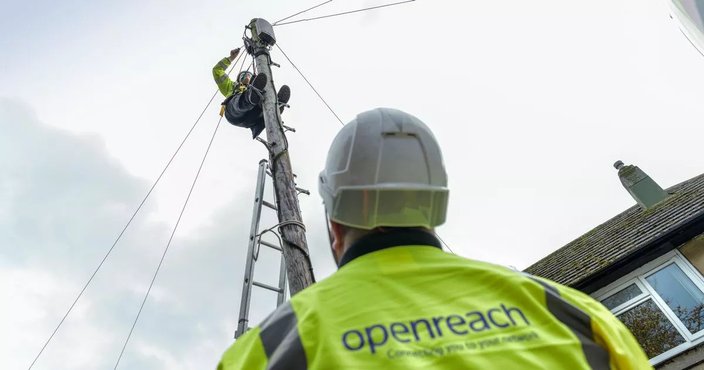
Openreach, one of BT Group’s subsidiaries, received the Sustainability Award from Connected Britain in 2024 for motivating suppliers to take climate action
How can other companies learn from what you have achieved?
Ian: “We engage with suppliers as groups and as individual suppliers. We engage with them in groups in workshops and webinars, but naturally, there are some things that they don’t want to discuss in front of each other. We therefore also have quarterly one-on-one reviews which give us a really good space to hold suppliers accountable and support them on a one-on-one basis. Both of these approaches are perfectly translatable to other forums as well.
“It is important to approach this in the right way, starting with what you as a company want to achieve. BT Group has a very clear objective and roadmap for emissions reductions. This is the touchstone that we always come back to in our dialogues.
“But then you have to account for what the supplier wants to achieve and their maturity, and based on that evaluate what is reasonable to expect from them. Sometimes, you have to upskill your suppliers before you can set expectations. And sometimes you need to bring examples from inside or outside their industry to show them what is feasible. We are not the experts in their field, they are, so we need to do our homework to understand their industry and what is feasible for them to do with their input”
John: “BT Group has applied this approach to major suppliers, which has been picked up by the Joint Alliance for CSR, where I am General Manager. Over half of the telecom companies in that body are now following this same approach with their major common suppliers, and this can be traced back to this project that BT Group started and is taking further forward.”
What are your hopes and ambitions for continuing this success? Are there any major obstacles that still need to be overcome?
Abby: “We have set some great foundations, but it will take consistency and ongoing collaboration to continue focusing on this and not get distracted. As the reports continue to come in, we need to see where we can help and where we can learn from our partners to improve on this process and share solutions.”
“We are now mandating that our partners have targets aligned with the Science-Based Targets Initiative and that they make annual submissions to the Carbon Disclosure Project, to make it incrementally more demonstrative that our partners are publicly facing in saying that they are taking climate action. We do this because we need to continue improving and developing our goals for supplier climate action. This helps our partners be more attractive in the market and creates a norm for climate action in their supply chains.”

Gabrielle Ginér, Head of Sustainability at BT Group
In a final comment, Gabrielle added:
“I think this is a great approach that we have demonstrated results in supplier carbon reductions. It would be great if we could inspire others to take a similar approach, because what we need on climate action is scale. We need exponential change where more and more companies are setting science-based targets and cascading this requirement into their supply chains.”
This initiative is part of BT Group’s overarching objective to be a net-zero company by the end of their 2031 fiscal year, and net-zero on all scope 3 emissions by the end of their 2041 fiscal year. To learn more about what BT Group is doing to achieve this, check out their profile here on We Don’t Have Time.