The way you choose to spend your money impacts the climate and the environment. All your consumer choices have a carbon footprint. According to the UN Gap Report, our lifestyles account for two thirds of global emissions. The good news is that you can drastically reduce your footprint through smart lifestyle changes that still let you enjoy life! Here’s a step-by-step guide. Step 1: Analyze your lifestyle emissions
“An investment in knowledge pays the best interest,” as Benjamin Franklin said. So start by mapping out your climate footprint. There are numerous web resources to help you with this. Go to our carbon calculator and take the test! It will tell you which aspects of your lifestyle that give rise to the most carbon dioxide equivalents – and give you practical tips on how to reduce your lifestyle emissions. Step 2: Make changes with a clear impact (and remember, no one is perfect)
So, now you have a roadmap that will help you focus on the things in your life that produce the highest relative footprint, which will guide you toward the most efficient way to reduce your footprint by spending your money differently.
Does traveling make up most of your footprint? Consider choosing greener alternatives such as train travel or electric cars. If you must fly, choose an airline that offers you to buy biofuel. Do you consume a lot of meat? You don’t need to go all-vegetarian, but mixing up your diet is very efficient. When you do buy meat, choose the most sustainably produced meat available to you. If you’re a fashionista, explore high end second hand shops or consider renting your party outfit.
Many times there are better alternatives that emit less with a low added cost while giving you the same satisfaction. And many times the more sustainable option is also the more economical one! What you want is to focus on choices that saves as much emissions as possible. Not to stop enjoying life.
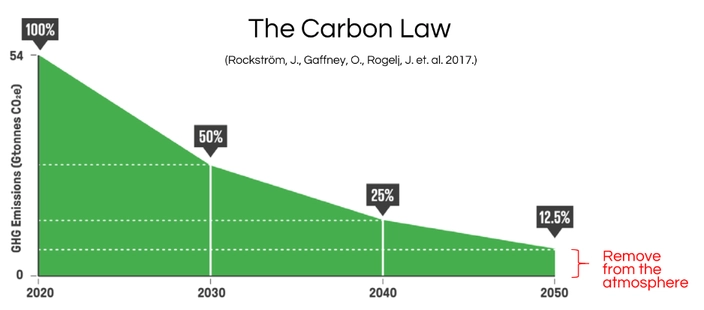
The world needs to halve emissions every decade in order to reach net zero by 2025, according to Johan Rockström and other leading climate scientists. This means you need to halve your emissions, too. Remember, you don’t need to be a perfect saint, the important thing is that you take action with a clear impact. Step 3: Choose genuinely green and ambitious brands
Move the market with your money by choosing genuinely green brands. Admittedly, this one is a bit tricky since most companies will tell you that their products are green. Look for companies that have sustainable, low-carbon products at the core of their offering and reason to be, which may require reading up a little on the company history and product line. A second tip is to buy from companies that have committed to emissions reductions in line with the Paris agreement’s 1.5° ambition, have clear transition plans, and are members of a third-party global initiative that evaluates such ambitions, like Science-based targets, Exponential Roadmap Initiative, or Race to Zero. A great source of information on how well companies perform on climate issues and how well respected they are is We Don’t Have Time. Come here to look up which companies have received a lot of Climate Love 💚. If you change your spending and consumption pattern, the effect on society is multiplied. You move the market with your money, inspiring others to live more sustainably. Together you create demand for low-carbon products and services, leading to an exponential change.
Final step: Move the money in your bank account!
Don’t forget about your savings! If you haven't done so yet, sign up for the #MoveThe Money campaign, and don’t forget to write in how much money you want to move. We will send you our guide on how to move your savings. This has the potential to reduce your footprint in half. So it’s actually the most important action you can take with your money. https://wedonthavetime.org/movethemoney
Should you have any suggestions for enhancing this guide further, please do not hesitate to contact us via email at david.olsson@
https://wedonthavetime.org