Regardless of what you think about civil disobedience as an effective tool to solve the climate crisis…
This is worth reading 👇
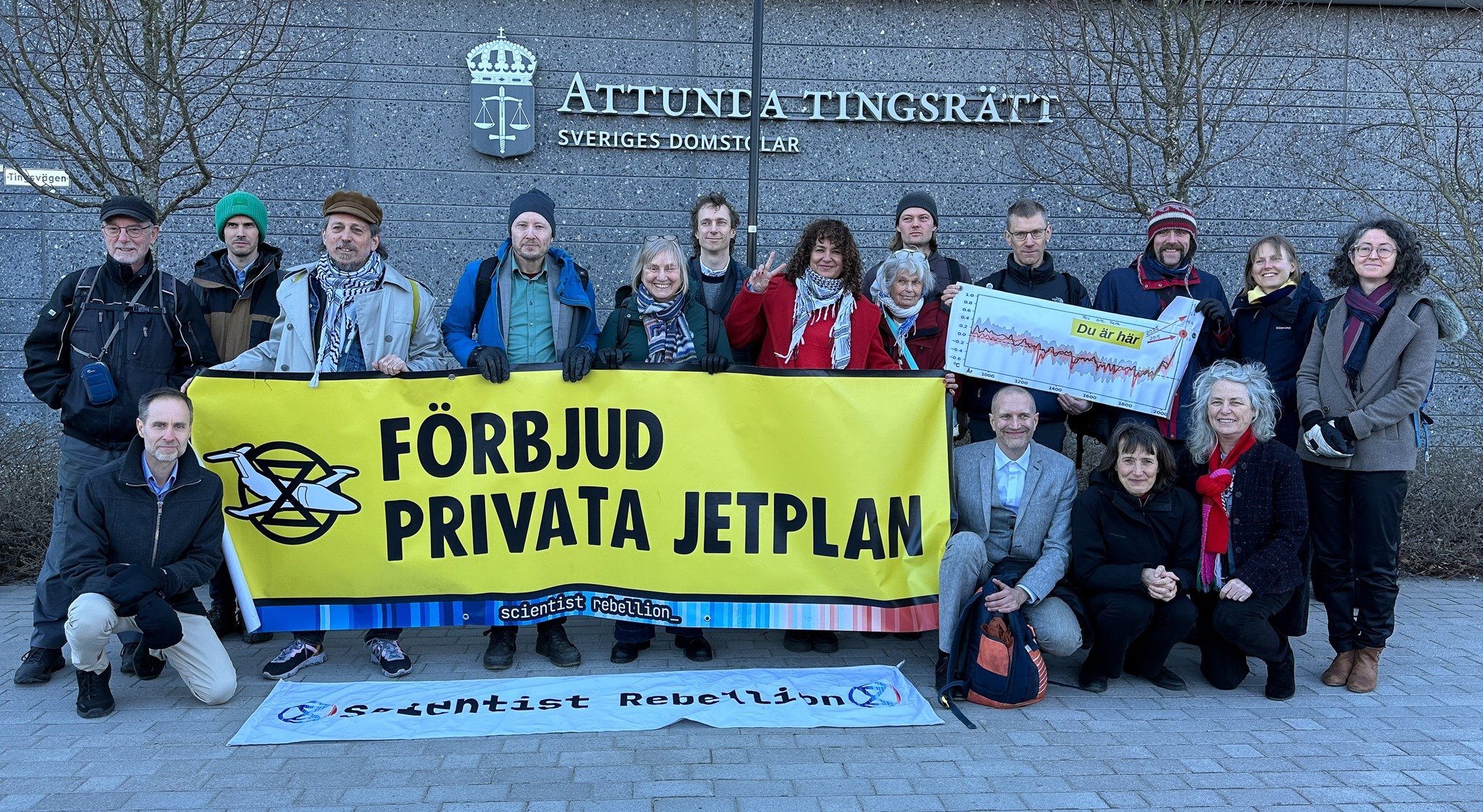
One of the activists behind a high-profile blockade of a private jet terminal in Sweden shares her testimony from court. She is not a criminal in the traditional sense. She is a scientist. A parent. A human being acting on what she knows.
Her words are powerful—and uncomfortable.
Read it. Then ask yourself: What would you have done?
-------------------------------------------------------------------
The trial is now over. It was a surreal experience.
For three full days, around thirty highly educated people—scientists, psychologists, engineers, lawyers, a judge, and jurors—sat in a high-security courtroom discussing whether it should be considered a crime to protest a deadly activity (private aviation) by holding banners while paint was sprayed on the facade of a private jet terminal.
All of this is happening while warnings about the climate emergency and ecological collapse grow more dystopian by the day. While wars and genocides continue. While fascism is once again rising in different parts of the world.
What a waste of time and judicial resources.
I am proud that I took part in the protest action we are now being prosecuted for. If I regret anything, it is that I did not act in line with my values much earlier—and that I don’t have the energy to do even more.
This was my first trial, so I have nothing to compare it to. But I’ve been told it was highly unusual. As one of the defense lawyers pointed out, this was not a typical criminal case.
Many of us were women.
The level of education among the accused was high.
The trial itself became educational about the climate emergency.
And the motivation behind the “crime” was not self-interest—but saving lives.
At the same time, there were unusual elements in a more concerning sense. Evidence was dismissed in ways that are rare.
But there were also positive aspects. We were largely allowed to speak fully. We could ask each other questions during questioning. And we were not brought into the courtroom under guard, despite being in a high-security setting due to space constraints.
I chose not to have my own lawyer to keep costs down in case I am convicted, so I defended myself. The process has taught me a great deal about the Swedish legal system.
In my closing statement, I chose not to focus on legal arguments such as the right to protest or international conventions. Instead, I explained why I acted.
-------------------------------------------------------------------
This is what I said:
In my research, I analyze long-term impacts on forests—30 to 100 years into the future.
Already in my first scientific paper over 20 years ago, my colleagues and I warned about the effects of climate change on forests. Since then, the warnings have only become more urgent.
And it’s not just forests. It’s all ecosystems.
We are already on track to lose coral reefs. Other ecosystems will follow.
Almost all complex life on Earth is at risk—including humanity.
Recently, I co-authored a study showing that large parts of southern Sweden will no longer be suitable for spruce trees before today’s young forests have even matured.
Despite doing everything I can to communicate these warnings—both professionally and in my free time—I am quite certain it will not significantly influence policy.
The problem is not a lack of knowledge. Scientists have been warning for decades.
The problem is a mix of democratic failure, disinformation, lobbying, short-term thinking, and greed.
And that problem cannot be solved with more research.
We must act on the knowledge we already have.
And as scientists, we have a special responsibility.
If people like me—who study the consequences of climate change—do not show through our actions that this is serious, why should society take it seriously?
I did not take part in this protest to cause damage.
I took part to save lives.
As a researcher, I work with long-term impact assessments. I made a conservative estimate of emissions from private jets using this terminal.
Those emissions alone could lead to around eight premature deaths during this century.
That is the harm I was trying to prevent.
I wanted to protest against a system where extremely wealthy individuals contribute to others dying prematurely.
I also acted because I know what it means to lose someone you love too soon.
My firstborn child died. I carry him in my heart every day.
If he had lived, he would have turned 20 in two weeks—around the same time the verdict in this trial will be announced.
His death was not caused by climate change.
But many other children and adults are already dying because of it.
And many, many more will die.
How many—depends on what we do.
Our passivity kills.
Our refusal to act kills.
I have two children who are alive. They are teenagers now.
Like any parent, I want them to have a good life—on a livable planet, in a stable society, with functioning ecosystems.
And we are on track to lose that.
Our children and future generations risk losing everything.
Completely unnecessarily.
Because research shows it is still possible to ensure decent lives for everyone within planetary boundaries.
But if we want that future, there is no room for luxury emissions like private jets.
I took part in this protest to give my children—and others—a chance at a livable future.
I also acted because I am aware of what happens when people do not resist injustice.
I grew up in Germany. I have often asked myself who I would have been in the 1930s, when it became clear where things were heading.
Would I have had the courage to resist?
Or would I have looked away, like most people?
I don’t know.
But today, we are in a situation with similar moral weight.
Millions—perhaps billions—of people risk premature death if we leave what scientists call the “safe climate corridor,” the temperature range in which human life can safely exist.
Whether we stay within that range depends on what we do in the coming years.
And I have decided who I want to be in this moment:
I will not be passive.
I will not be a bystander.
I want to be able to look back in 10, 20, or 30 years without regret—knowing I did what I could.
My participation in this protest was an act of love.
I acted because I love life on this planet.
If I am convicted for doing what I believe is morally right, based on what I know—so be it.
At least I will be able to look my children in the eyes and say:
I did everything I could to protect your future.
And that matters more than anything.
The verdict will be announced on May 4 at 11:00, 2026.
// Jeannette Eggers, one of the scientists on trial. This text was originally written in Swedish and has been translated into English and published on We Don’t Have Time with the author’s permission.