The young data center sector is doubling in size every four years. Data centers are large consumers of electricity, which is largely converted into heat.
The participants in the Dutch Data Center Association (DDA), the trade association of data centers in the Netherlands, represent about 90% of all data center capacity in the Netherlands. The organization regards sustainability and energy as core themes. Stijn Grove, director: “With a view to this mission, we as a sector offered our residual heat to the Netherlands free of charge at the beginning of 2017. We are now also active in various projects throughout the Netherlands to link data centers to heat consumers. ”
One million households
According to the DDA, the residual heat from data centers is enough to heat a million Dutch households, but no major projects have got off the ground since last year's supply. Stijn Grove: “Our offer as a data center sector is still standing, we are happy to help by making our residual heat available free of charge. We ask the government to enter into more concrete discussions with us as a sector so that together, rather today than tomorrow, we can achieve the accelerated transition to sustainable energy.
The organization has now published the report "Datacenter & Residual Heat" in collaboration with sustainable energy consultant Greenvis and TNO. This provides an overview of information and parties, the possibilities of and needs for data center residual heat and a number of examples of already started projects. In October 2017, the Green Data Center Platform was also officially launched: a knowledge network where everyone can share 'green data center' initiatives. Interested parties can join here.
Heat networks
Data centers like to be packed together for efficiency reasons. At the thick internet cables, at the high voltage and near the user. Residual heat must therefore be transported over relatively large distances, but because cooling water at 35 ° C does not lose a lot of heat on the way and houses are now built so well insulated that no water at 70 ° C is needed for heating, this is no objection. . Renewable energy generated by wind and sun, with a very irregular generation pattern, can be combined with that from data centers that have a very predictable pattern.
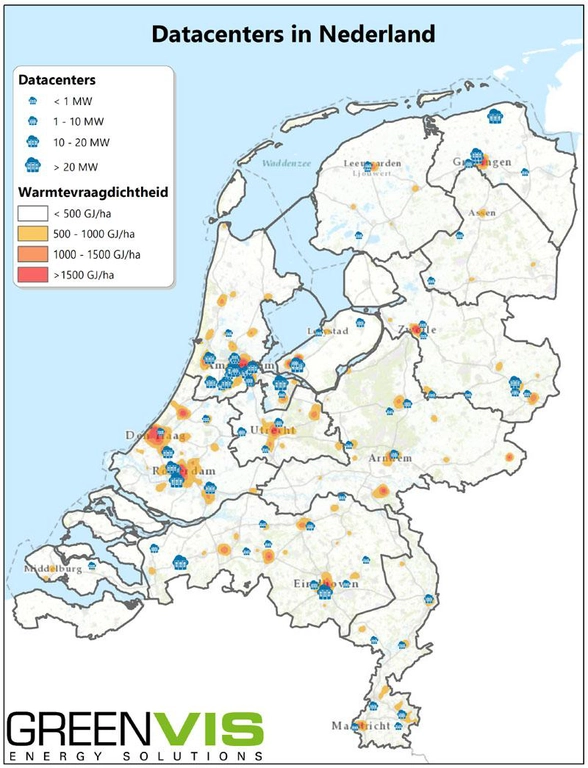
In cities, there are great opportunities to significantly reduce CO2 emissions through heat networks. By using and combining heat sources such as geothermal energy, industrial residual heat and data center residual heat as smartly as possible, the climate goals can be achieved. Greenvis, together with the data center sector, has made a combination of the data center map and the heat network maps in the Netherlands. This clearly shows where the most potential lies.
https://www.agconnect.nl/artikel/datacenters-geven-voorbeelden-van-toepassen-restwarmte

Dutch Data Center Association
Climate love