Powering the Planet: Why Engaging the Next Generation Matters Now
Electricity sits at the heart of two global imperatives: electrification and decarbonization. The energy transition is complex, no doubt. Success hinges not just on technology, but on people.
During a recent digital broadcast hosted by We Don’t Have Time and Hitachi Energy, and inspired by The Journey of Electricity animation series, energy experts and youth advocates explored the challenges and opportunities of building an electrified, carbon-neutral future. Their insights reveal the human dimensions often overlooked when discussions only focus on infrastructure and technology.
https://www.youtube.com/watch?v=zncD0w7RTJs
Grids in Transition: Technology, Security, and Access
The energy transition is a marathon, not a sprint. According to the IEA, achieving net zero emissions by 2050 requires a full transformation of the global energy system. Thankfully, clean energy technologies are mature and being rolled out at a scale and speed surprising even to veteran analysts—not primarily because of climate goals but for their superior economics.
Dr. Gerhard Salge, Chief Technology Officer at Hitachi Energy, notes that renewables like solar and onshore wind are now “not only the lowest carbon opportunities in generating electricity but also the lowest cost and the fastest to build.” That advantage is growing and makes the transition increasingly attractive.
But clean generation is only one part of the puzzle. Transitioning successfully requires solving for the system itself: generation, demand management, grid resilience, and energy storage. “Power generation is just one element,” says Gerhard. “It really needs to come together in all of the dimensions.”
As we rely more on electricity, stable grids move from a secondary issue to a central element in global security. Sherri W. Goodman, Secretary General of the International Military Council on Climate and Security, highlights this often-overlooked link between energy and national security: “Energy security is national security. And being able to have secure energy supplies under all conditions is what protects us globally.”
Expanding access also remains a major challenge. Despite progress, hundreds of millions of people remain without reliable access to electricity. The key dilemma: How do we bring electricity to underserved communities without adding decades of new emissions?
The direction of travel is clear. How fast we move will be up to people—especially young people. “We need the next generation of young professionals with the passion but also with the competence and the excitement to drive this energy transition forward,” says Gerhard.
A New Generation’s Vision for a Clean Energy World
The energy transition isn’t just about technology and economics—it is a chance to reshape society. Many young leaders see it as a pathway to fairer and more dynamic communities.
Mahak Agrawal, Board Member of the International Tunnelling and Underground Space Association (ITACUS), sees the shift as deeply social: “The electric future isn't just about cleaner fuels or which electric vehicles to buy. It's more to do with rethinking how cities function, whom they serve, and the often invisible infrastructure that holds them together,” she explains.
And it only works if everyone can access that future.
Hikaru Hayakawa, Executive Director of Climate Cardinals, points out that most climate content is in English, yet less than 20% of people worldwide are fluent in it. And far too little of it is aimed at a younger demographic. “People under 30 are half the world's population,” he says. “We're not only the most impacted by outdated energy systems, facing challenges like power outages, pollution, rising costs, but we're also the most fluent in the innovations driving change.”
Marco Gervasi, a Youth Energy Ambassador from the European Climate, Infrastructure and Environment Executive Agency, envisions electricity as a key enabler for better lives across the board: “An electric future means a society powered by clean renewable energy where electricity is not just a commodity but is an enabler for sustainability and opportunity.”
Together, these young voices remind us that the energy transition is a generational opportunity to do better in so many domains. But only if everyone is included.
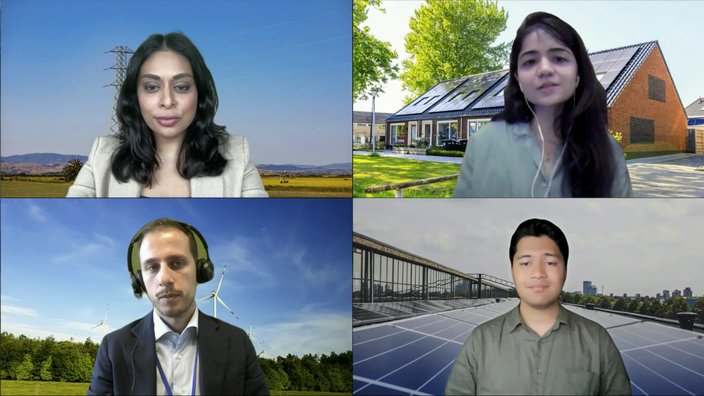
Clockwise from the top left: Dr. Sweta Chakraborty, Host; Mahak Agrawal, Board Member, ITACUS; Hikaru Hayakawa, Executive Director, Climate Cardinals; Marco Gervasi, Youth Ambassador, European Climate, Infrastructure & Environment Executive Agency
Join the Charge: Everyone Plays a Role
The technologies largely exist. What’s needed now is scale, storytelling, and engagement.
That means making electrification relatable, not abstract or for an elite few. As Mahak says, “it's rarely the science that sticks with the communities or with the policymakers, it's actually the stories.”
To build public trust and accelerate the shift, the energy sector must welcome new voices and challenging questions. Gerhard makes it clear: “There is no wrong or stupid question—ask the questions which you want to have answered and if we give a too complicated answer in the first round, ask us again.”
The path forward calls for collective effort across the whole of society. It's about enabling participation from diverse roles, sectors, and geographies. The energy transition can—and must—be a source of economic opportunity, innovation, and social equity.
The transition is already underway. The time to get involved is now.
Watch the full broadcast, The Journey of Electricity, below:
https://www.youtube.com/live/Gt7l7wS8Jsc?si=YO-Kj1sA_Nw6KQHm