On Wednesday morning, part of a glacier high in the Himalayas broke away and crashed into the valley below. Ice, rock and water tore through communities along the border between Nepal and Tibet, destroying homes, roads and bridges. Scientists have reconstructed the collapse from satellite imagery
There will be investigations into exactly what happened. There should be. Families deserve answers, and people living below other glaciers need to know what can be done to protect them.
But here is what worries me. Once the rescue operations disappear from our screens, we will have learned precisely how a mountain came apart. Will that knowledge follow us into the next discussion about whether cutting emissions is too expensive, or whether another delay is reasonable?
After nearly a decade of working on climate, I know the honest answer: not on its own. That separation, between what we learn from disasters and what we allow into decisions, is the subject of this article.
London, 1944
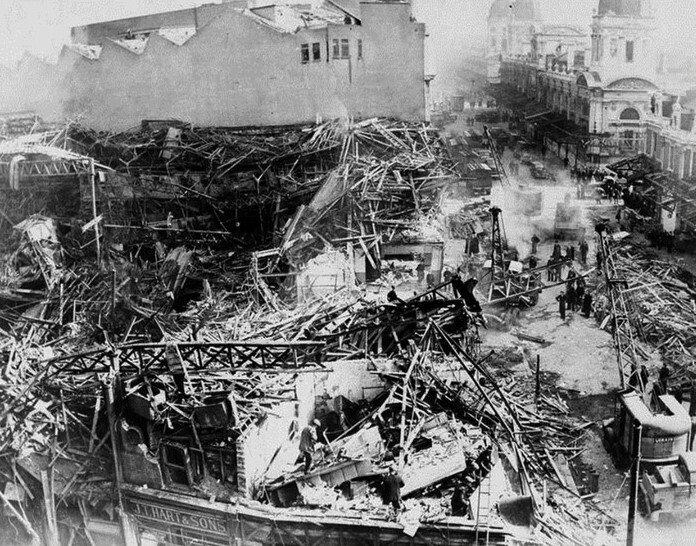
An archival photograph showing the aftermath of a V-2 rocket strike in London.
In September 1944, explosions began hitting London without the warning people had come to expect from air raids. These were German V-2 rockets. The British government knew, but initially withheld the truth while the explosions were officially described as gas leaks, ruptures in the gas mains that ran beneath the city’s streets. Londoners gave the weapons a name of their own: “flying gas mains.”
The government feared panic, propaganda and giving Germany information that could help improve its aim. Those concerns are documented in historian Charlie Hall’s study of the secrecy surrounding the attacks.
There were military reasons for keeping quiet. There were also people on the receiving end who knew the explanation they were being given did not make sense.
I keep thinking about that nickname. It captured something people understood without an official announcement: you cannot explain what is happening by leaving out the most important part.
What We Know, And What We Don’t
The comparison has a limit. London’s government knew the cause. Scientists investigating this week’s glacier collapse are still reconstructing the exact chain of events.
Consider how this story began. The first reports blamed an earthquake. The US Geological Survey initially registered a magnitude 4.4 quake, then revised its analysis: the seismic signal was not an earthquake that brought down the mountain. It was the mountain coming down, so violently that it registered as one. The collapse shook the earth, not the other way around. So the very first explanation the world heard pointed away from the cause, and nobody had to order it.
But they are not starting from zero. Mats Eriksson, head of georisks and geodata at the Swedish Geotechnical Institute, told Dagens Nyheter how retreating glaciers can leave unstable ice clinging to mountainsides and meltwater trapped behind natural dams. When the ice falls or the water breaks through, the consequences can be catastrophic. Eriksson linked these mechanisms to global warming. Asked whether warming was behind this disaster, his answer was direct: “Absolutely.” Glaciers have been shrinking throughout the twentieth century, he explained, with the retreat accelerating sharply over the past decade or so.
Asked whether warming was behind this disaster, his answer was direct: “Absolutely.”
He is not alone. “Everything, probably directly or indirectly, is pointing the finger towards global warming,” Arun Bhakta Shrestha, hydrologist at the International Centre for Integrated Mountain Development in Kathmandu, told NPR. A glacier collapsing does not, by itself, prove that climate change caused that particular collapse. Nor does attribution science simply attach a percentage to an answer we already know. The investigation into which of the three scenarios played out matters. But notice what the remaining uncertainty is about. It concerns which door the flood came through. It does not concern who has been unlocking the doors.
The knowledge we already have points the same way. In 2023, the International Centre for Integrated Mountain Development reported that glaciers across the Hindu Kush Himalaya had lost ice 65 percent faster between 2011 and 2020 than in the previous decade. It warned that warming and the loss of frozen ground would increase threats from landslides and floods. These were warnings about risks to people’s lives, homes and water supplies across the region. We also know why the planet is warming. Burning coal, oil and gas is the principal driver of the warming observed since the preindustrial era. That connection is established science.
We can report all of this while being honest about what remains unknown in Nepal and Tibet. Readers are capable of understanding both.
Where Does The Explanation Stop?
But mentioning climate change in a disaster story cannot be where the work ends.
When governments weaken emissions rules or companies expand fossil fuel production, report the risks alongside the investment and jobs. What damage could follow? Who pays?
We cannot report melting glaciers on one page and the supposed benefits of delaying climate action on another as though they have nothing to do with each other.
That is the flying-gas-main problem. Describing the destruction without following the explanation far enough. Ice fell. Water surged. What made the mountain more vulnerable? What decisions are increasing the risks?
Nobody needs to order a cover-up for those questions to go unasked.
The Biggest Lie
I recently wrote about the biggest lie ever told: we have more time.
https://thebiggestlie.wedonthavetime.org
It survives perfectly well among people who accept climate science. You can agree that the planet is warming and still argue for another postponement. You can express sympathy for people losing their homes and never ask whether your own decisions are increasing the risks others will face.
I find that much more difficult to deal with than someone who simply denies the science. At least with denial, the disagreement is clear.
With delay, everybody can sound concerned. The decision still gets postponed.
Of course we should argue about the best way to cut emissions. Costs matter. Jobs matter. So does whether people can afford the transition. I run a company; I know that practical constraints do not disappear because a goal is important.
But the cost of waiting belongs in that argument. It cannot keep being left for the disaster coverage.
Eriksson gave Dagens Nyheter a sentence that belongs in every one of those debates. Nepal keeps a close watch on about ten dangerous glacial lakes, he explained, but judging how unstably the glaciers themselves sit on the slopes is far harder:
“We know that events like this will happen, but we do not know exactly where, and above all not when.” Watching the glaciers, he said, “requires resources that neither the research community nor the authorities have.”
“We know that events like this will happen, but we do not know exactly where, and above all not when.”
Read that again. The science can see the threat forming. The resources to watch it are not there. And every year of delay adds more meltwater lakes, more hanging ice, and more valleys that need watching.
I am not claiming that a different policy last month would have prevented this week’s collapse. I am asking why uncertainty about one event should give us permission to disregard what we already know about growing risks.
The families searching for someone in Nepal and Tibet deserve help now. Communities across these mountains deserve better protection. Neither obligation ends when the cameras leave.
And the rest of us need to carry what we learn into the places where decisions are made.
When someone says we can afford to wait, ask them what risks they have included in that calculation. Ask who will bear them. Ask what evidence would make them change their mind.
We should be just as persistent about those answers as we are about understanding why a glacier fell.
Londoners did not need another description of an explosion. They needed an honest explanation of what was hitting them.
So do we.