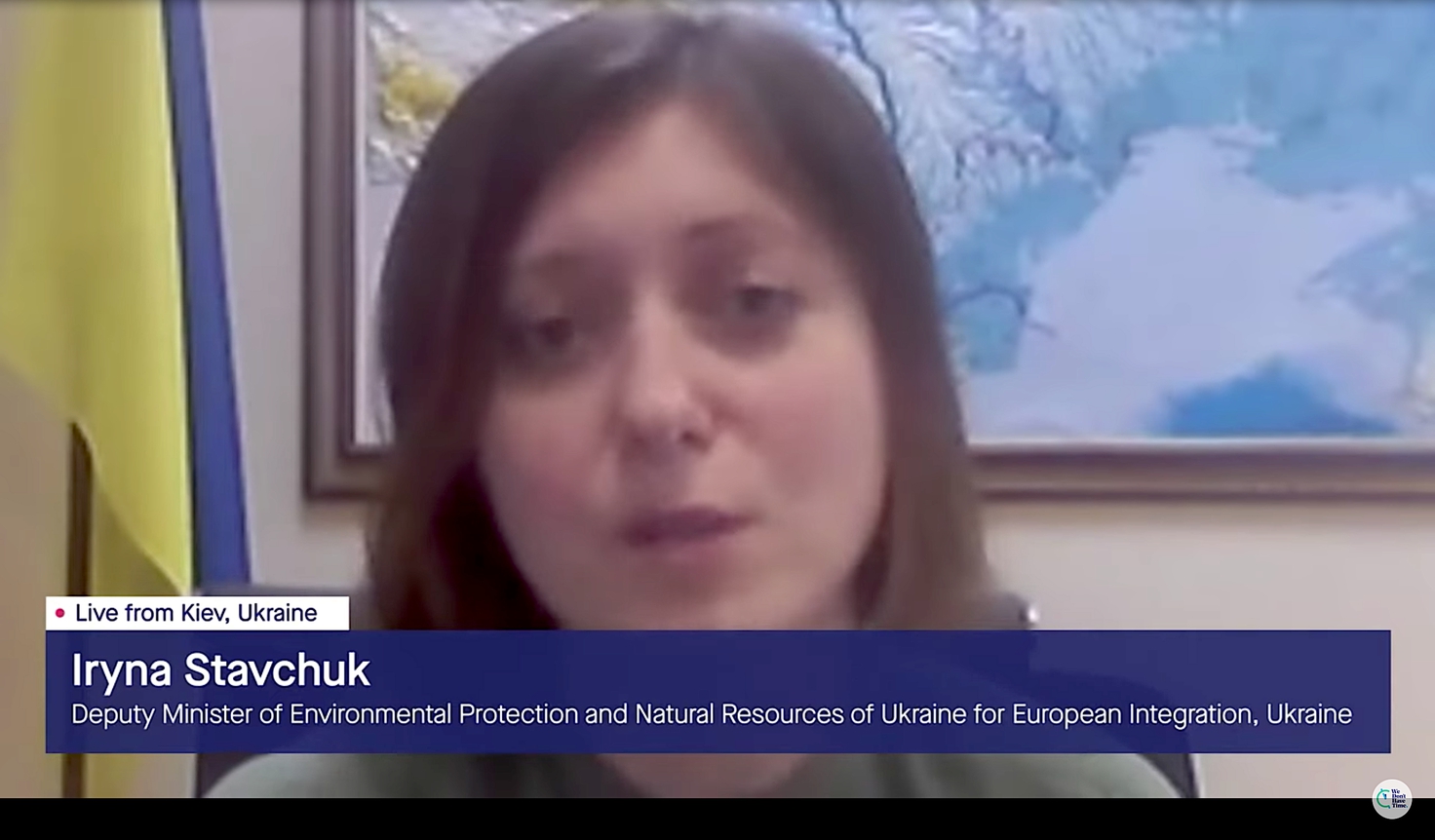
After two months of conflict in Ukraine, the potential scale of the war on the country’s environment and thus the health of its people is starting to emerge.
In a keynote speech at We Don’t Have Time’s Earth Day broadcast, Ukraine’s Deputy Minister of environmental protection and natural resources, Iryna Stavchuk, said the Russian invasion is also causing environmental damage that will affect the country for decades.
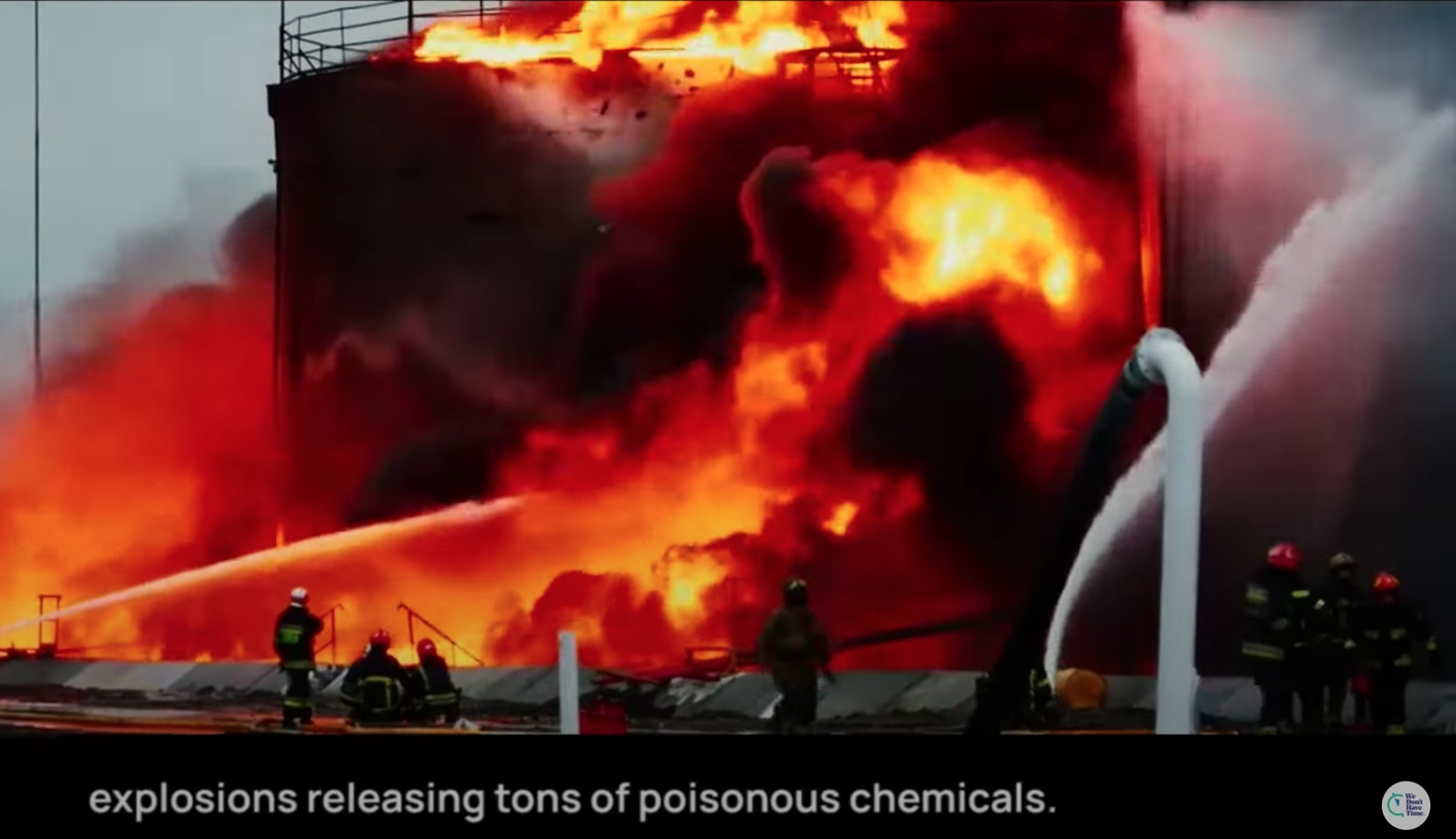
Snapshot from the film about the environmental damages of the Russian invasion in Ukraine, shown by deputy minister Iryna Stavchuk as part of her keynote at the "Nature in The Race To Zero” broadcast.
From the pollution of land and water linked with weapons and the destruction of key infrastructure to radiation linked with Russia’s seizure of the mothballed, stricken, Chernobyl nuclear plant, the scale of damage to Ukraine’s natural life support systems is starting to be glimpsed, say the authorities there and experts around the globe.
Since the start of the invasion on February 24, the war has devastated not just Ukrainian lives, but Ukrainian nature reserves, livestocks, delicate ecosystems, and – with the Russian presence in Chernobyl and the Red Forest – threatened to disturb the highly dangerous irradiated areas of the country, too.
The findings and the fears formed part of the Environment in Time of War segment of the Earth Day programme broadcast by We Don’t Have Time in partnership with EarthDay.org on 22 April. It was viewed by well over four million people from the overall 13 million audiences that day. https://youtu.be/Y_elTSUzf_0?list=RDCMUC8Dx8uCHYormjKjjHW7vg5w&t=13
Watch the segment "Environment in Time of War" from the broadcast "Nature in The Race to Zero".
Iryna Stavchuk, Ukraine’s Deputy Minister of environmental protection and natural resources introduced the segment, sharing her perspective on the impact of the Russian military in the country and how their actions are causing as much harm to the environment as they are to the people.
From the intentional or careless damage to land and urban areas, to the usage and waste material of military equipment, and even to the damage and theft of key pieces of equipment and infrastructure put in place to contain and reduce the radioactive impact resulting from the Chernobyl Disaster in 1986, these actions have and will continue to lead to generational devastation to the peoples of Ukraine and the land upon which their livelihoods depend.
These actions are also incredibly difficult to assess without easy access to the region from independent organizations or even local authorities. However, as outlined in a recent Wall Street Journal article, organizations such as PAX, a Dutch nonprofit and Conflict and Environment Observatory, a U.K. charity, have been able to extrapolate significant environmental threats through a mixture of eyewitness posts on social media in combination with cross-referencing satellite images and Google Earth maps.
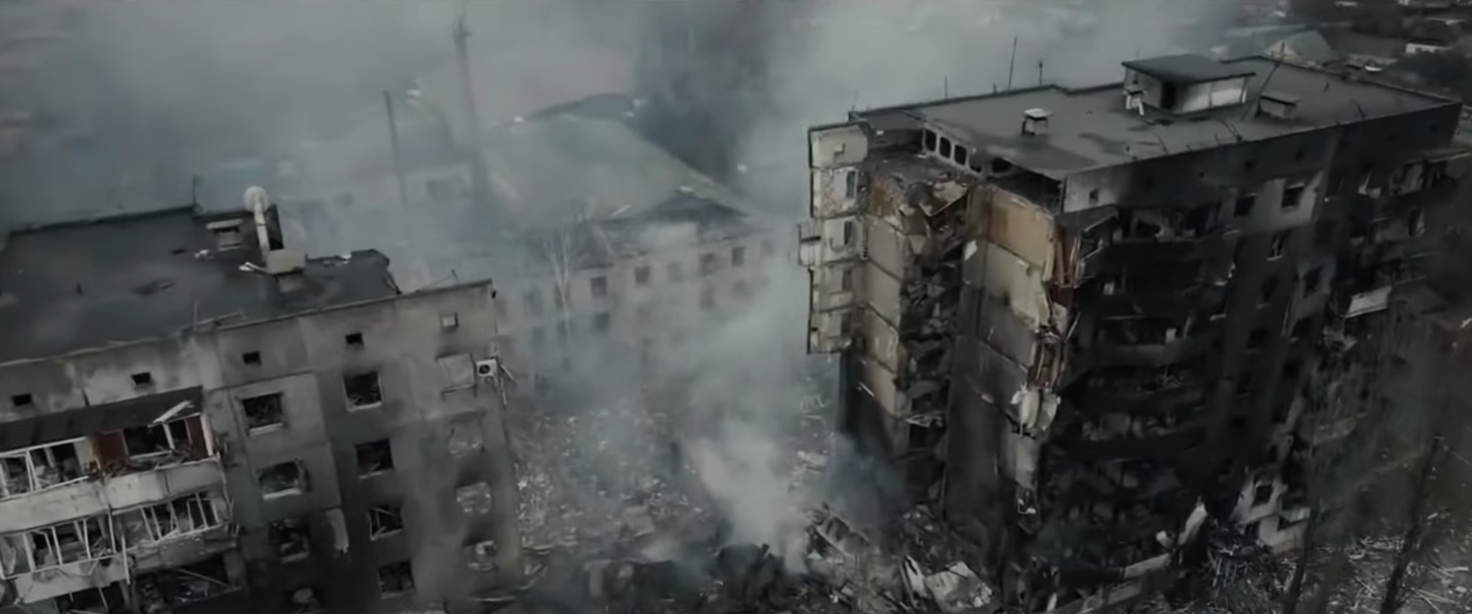
From the Ukrainan film on environmental damages caused by the ongoing war.
The groups have additionally documented damage at over 100 sites, ranging from power plants to water-treatment plants, ratifying both what Ukrainian environmental agencies have uncovered and what Stavchuk said during our broadcast.
“The release of greenhouse gases which were embedded in numerous destroyed infrastructure, military equipment, and buildings which now will have to be rebuilt… We also expect that the war will have global impacts on climate because financial resources might go to military expenditures rather than directed to climate change mitigation and adaptation programs,” Stavchuk says
She further stated that this will become as much a global issue as a Ukrainian one, particularly related to food supply and the impact on agriculture, as well as the dependency on fossil fuels as part of a military conflict.
She said, “One third of Ukrainian territories will not be able to plant agricultural products”, which will affect both the costs and production of foods to Europe and the world, as Ukraine is “one of the major suppliers”.
Indeed, according to the United Nations, Ukraine is the world's sixth-largest exporter of wheat as of 2021, shipping 20 million tons of wheat and meslin (a mixture of wheat and rye) as well as being one of the world's top exporters of barley and sunflower seeds.
However, during her opening remarks, deputy minister Stavchuk hoped there would be a glimmer of hope as a result of this regime in regards to the dependence on fossil fuels. “In a good sense, we hope that many countries all over the world, including my own, will aim to reduce their dependence on fossil fuels as much as possible. The Russian regime and this war to a large extent is funded with fossil fuel exports to Europe and other countries, from Russia.”
The notion that this war is funded by the world’s dependence on Russian fossil fuels, already harming the planet on their own, might hopefully lead to further global initiatives that not only mitigate the recurrences of conflicts such as these, but also provide the opportunity for nations and communities to remove their reliance on fossil fuels entirely.
Other panel members, who are all experts in the impact of natural or manmade disasters on the planet, all echoed this sentiment throughout the broadcast.
Stefan Smith, Senior Programme Manager for Disasters & Conflicts at United Nations Environment Programme (UNEP), iterated that humanitarian and environmental infringements are “the same thing”, namely providing safe urban areas, rural zones, clean water supplies and protection of natural resources and regions.
Michael Bothe, Professor Emeritus of Public Law, J.W. Goethe University stated: “Avoiding and repairing environmental damage means preserving the conditions for a bearable life during and after the conflict. There is no peacebuilding without the restoration or preservation of the environment.”
Even the impact of activities such as the placement of land mines or the detonation of military equipment such as bombs pose a long-term threat to specific zones of the country, as well as to the effective management of these regions by the people living there.
Indeed, the lasting implications of Russian military action in Ukraine will be difficult to measure, even now, but the resulting impact from the destruction of properties alone could lead to the buildup of toxic waste in these regions, depending on how those structures were initially built, that could have long-term impacts not just on current nationals, but on future generations, too.
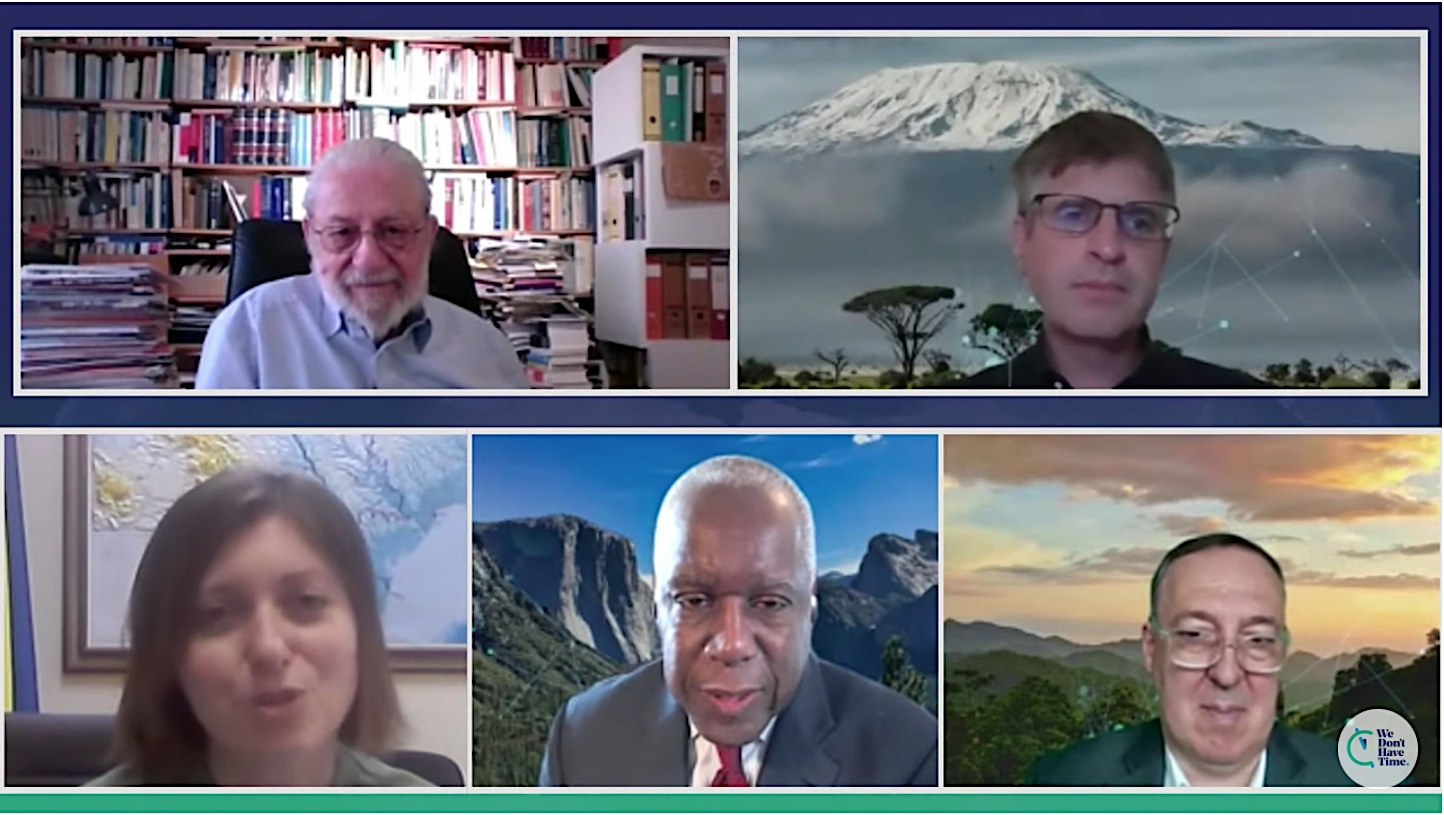
The panel on ”Environment in time of war”. From top left to bottom right: Michael Bothe, Stefan Smith, Iryna Stavchuk, José R Allen, and Carl Bruch.
One of the challenges in understanding the results of conflicts like those in Ukraine comes from being able to accurately assess the impact of military action within a region or country.
The inability of organizations or groups to safely conduct environmental reports without risk to their lives means that providing key insights and thereby actionable mitigation and remedial initiatives are severely hampered.
Bothe stated that while there are indeed local activists attempting to make these assessments on behalf of their country and global communities, it will require action from larger bodies such as the UN Compensation Commission (UNCC) and UNEP, and more in order for the consequences of the conflict to be measured and for relevant actions to be implemented.
Yet accountability is another issue, particularly from the standpoint of compensation and remediation, too, some panelists acknowledged. Assessing exactly what needs to be done to restore nature and human activity from this conflict is easier said than done.
José R. Allen, Former Commissioner at UNCC, outlined that from a compensatory standpoint, understanding exactly the environmental and humanitarian impacts of this conflict requires “having good monitoring and assessment, being able to measure the increment of damage, and being able to prove that increment of damage”.
Indeed, no one conflict is like another, and finding resolutions that provide justified remediation and compensation to the affected peoples and lands of Ukraine cannot be solely based on instances of conflict in the past, but will require dedicated, active assessments from international and local bodies in order to be fully understood and thereby acted upon.
However, he further stated that providing environmental and restoration efforts following the conflict is as vital as providing financial support for economic recovery and the rebuilding of infrastructure.
Holding the key players accountable, in this case the Russian government and military body, is also a challenge, both from a civil and criminal standpoint.
“There is no international court which has jurisdiction on the matter,” Bothe stated, outlining that not only is it a challenge to determine exactly what Russia is liable for as a result of their military action, but gaining access to funds from them as aggressors will be another hurdle to overcome in order to provide remedial imperatives for Ukraine.
Written by BERTIE NUTTALL
https://www.wedonthavetime.org/events/nature