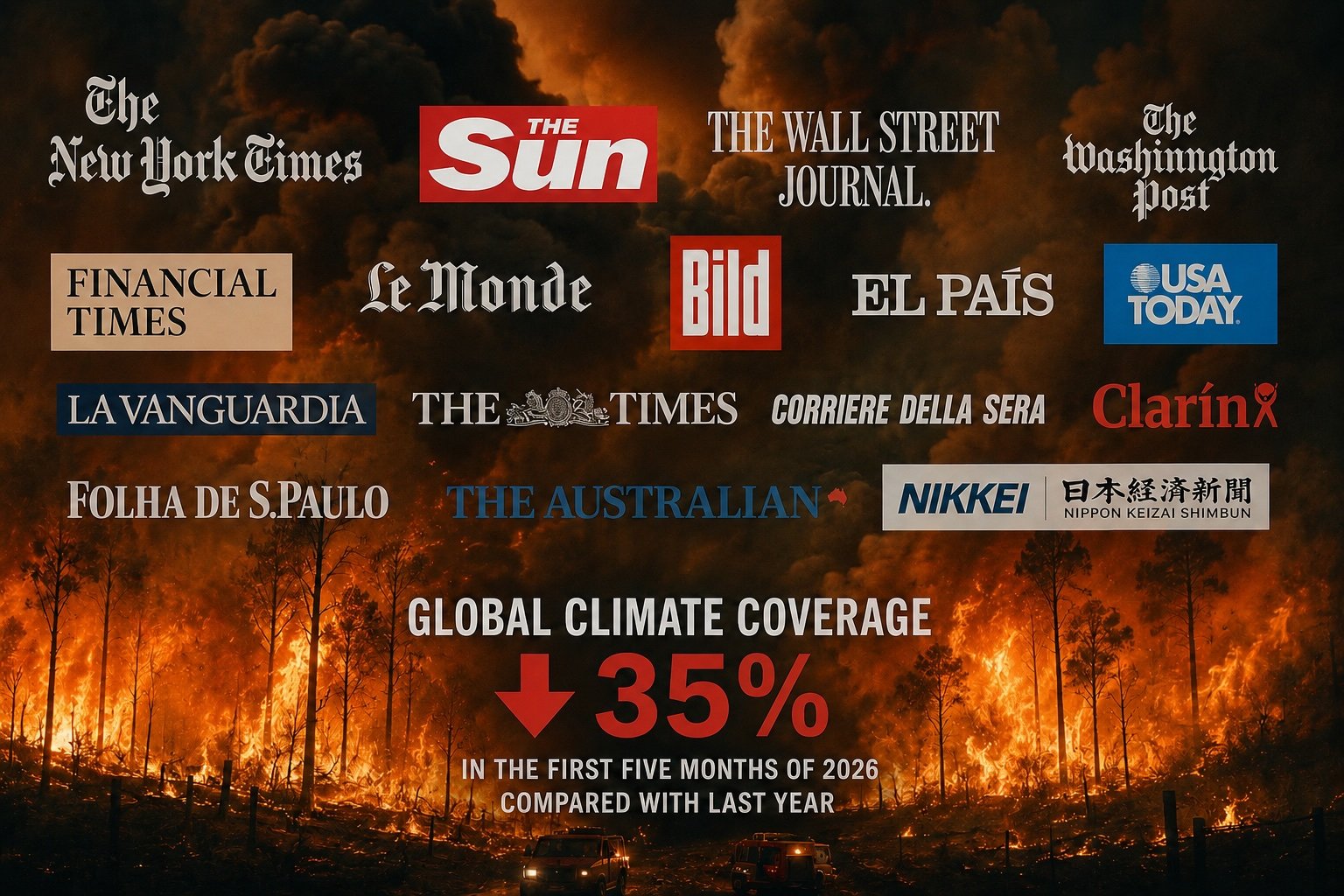
As the climate crisis intensifies, news organizations are devoting less attention to it. According to the Media and Climate Change Observatory, global climate coverage during the first five months of 2026 was down 35% compared with the same period in 2025.
It has been a summer of extreme heatwaves, massive floods and raging wildfires around the world. But as the effects of the climate crisis now become more and more visible, these changes are not reflected in the media coverage of this unfolding crisis.
This was clearly visible at the June UN Climate Meetings (SB64) in Bonn, Germany. This annual mid-year interim climate negotiations bring together technical experts and diplomats to advance the Paris Agreement and prepare for the COP31 summit in Turkey in November. As Climate Home News noted, this year only 135 journalists registered to attend — the lowest number since 2021, when the COVID-19 restrictions limited travel. Reuters, Bloomberg and the BBC all sent fewer reporters than before, or none at all. And it is not only the declining volume of coverage that is concerning. The quality of climate reporting also matters. As the examples below show, scientific findings linking extreme weather to climate change are often absent from news coverage, while some media outlets also give unchallenged airtime to people spreading climate misinformation.
A few examples of how this plays out:
⚠️ Germany: Climate change accounted for an average of 0.9% of news coverage across a sample of major German media outlets during the first quarter of 2026, according to the University of Hamburg's Climate Matters project. Researchers note that attention has declined since 2023 and remains well below the record average of 2.3% reached in 2019.
⚠️ United States: Climate coverage on the three largest U.S. broadcast networks (ABC, CBS and NBC) has fallen 35% since 2024, according to Media Matters for America, despite increasingly frequent climate disasters. The decline comes as climate reporting has lost airtime to politics, wars and economic news.
⚠️ Sweden: Until recently, both of Sweden's public broadcasters—SVT and SR—had dedicated climate correspondents. Those specialist roles have now disappeared, with climate reporting instead being integrated into the general news operation.
⚠️ United Kingdom: Across the UK's nine largest national newspapers, 72% of nearly 2,500 articles about June's record-breaking heatwave failed to mention climate change, according to the Energy and Climate Intelligence Unit (ECIU). Fewer than one in twenty articles mentioned net zero or climate policy, despite scientists concluding that human-caused climate change made the heatwave far more likely.
⚠️ France: During France's first major heatwave this year, the Observatoire des Médias sur l'Écologie identified 62 instances of climate misinformation across news programmes on 18 national television and radio stations. That is nearly five times the weekly average recorded in 2025. Nearly half of the misinformation came from political guests who were not challenged, while journalists and commentators accounted for another 38%.
💚 These examples should not overshadow the outstanding work of climate and environmental journalists around the world. Many continue to report under extraordinarily difficult conditions—facing intimidation, legal harassment, physical violence and, in some cases, losing their lives. Just a few weeks ago, a journalist covering environmental issues was killed in Lebanon.
📺 To better understand the challenges facing climate journalism today, watch our "Protecting Democracy" session from COP30, where reporters from around the world discussed the threats they face when covering climate and environmental issues. Also watch our interview with former TV meteorologist Chris Gloninger, who began receiving death threats after connecting science to his weather reports on US television. https://www.wedonthavetime.org/events/cop30-fullprogram
What’s at stake?
Why does declining climate coverage matter? Because democracy depends on citizens having access to accurate, relevant information about the decisions that affect their lives. People are being asked to vote on energy policy, transport, taxation, land use and disaster preparedness—all of which are increasingly shaped by the climate crisis. When the public receives less information about the causes, consequences and possible responses, it becomes harder to evaluate political promises, hold decision-makers accountable and make informed choices.
The media does not simply report what is happening; it also influences which issues society regards as important. Decades of agenda-setting research have shown that the prominence given to an issue in the news affects how important the public considers it. If climate coverage declines, the crisis may appear less urgent even as its impacts become more severe.
This makes the quality of coverage just as important as its quantity. Reporting heatwaves, floods or wildfires without explaining the role of climate change leaves audiences with an incomplete picture. Drawing on multiple studies from around the world, the Intergovernmental Panel on Climate Change (IPCC) concludes that the characteristics of media coverage play a major role in climate understanding and public perception. Giving misleading claims equal weight to established science can also create confusion where the evidence is clear. Journalism's responsibility is not to tell people what to think, but to ensure they have the information needed to think critically and make informed decisions. When one of the defining issues of our time receives less sustained scrutiny, misinformation faces less resistance, decision-makers face fewer difficult questions, and citizens are less well equipped to judge whether governments and companies are responding adequately.