Seven of the nine Planetary Boundaries are now outside the safe operating space, with all seven at their highest recorded levels of transgression, according to the Planetary Health Check 2026.
The annual assessment, produced by the Planetary Boundaries Science Lab at the Potsdam Institute for Climate Impact Research (PIK) and authored by more than 60 scientists, tracks the state of nine processes that regulate the stability and resilience of the Earth system. The seven transgressed boundaries are climate change, biosphere integrity, land-system change, freshwater change, biogeochemical flows, novel entities and ocean acidification. Ocean acidification became the seventh boundary to be breached in 2025.
Stratospheric ozone depletion and atmospheric aerosol loading are the only two boundaries to have improved over the past decade, according to the report. The researchers note that the global assessment of aerosol loading can mask unsafe levels in some regions.
“Pressure is rising across every Planetary Boundary already outside the safe operating space,” said Boris Sakschewski, lead author of the report. “It means that the risk of large-scale, persistent and potentially irreversible change is increasing.”

”Accelerating action to return to the safe operating space across all Planetary Boundaries is essential to protect lives and livelihoods”, says Johan Rockström, co-author of the report.
Extreme events add to pressures
The report assesses developments during a period of record ocean heat and major floods, droughts, wildfires and heatwaves.
Pakistan’s 2025 monsoon floods affected more than 6.9 million people. Global ocean heat content reached a record in 2025. Between January 2023 and September 2025, bleaching-level heat stress affected about 84.4 percent of the world’s coral reef area, according to the report.
In 2026, Western Europe recorded its hottest June–July period on record, while August was the hottest month ever recorded globally. Drought affected France, Spain, Germany and the United Kingdom, and wildfires occurred across parts of Europe and Canada. Record temperatures were also recorded in Japan, South Korea and parts of the Middle East.
The report links some of these impacts to interactions between climate change and other pressures, including ecosystem degradation, water stress and land-use change.
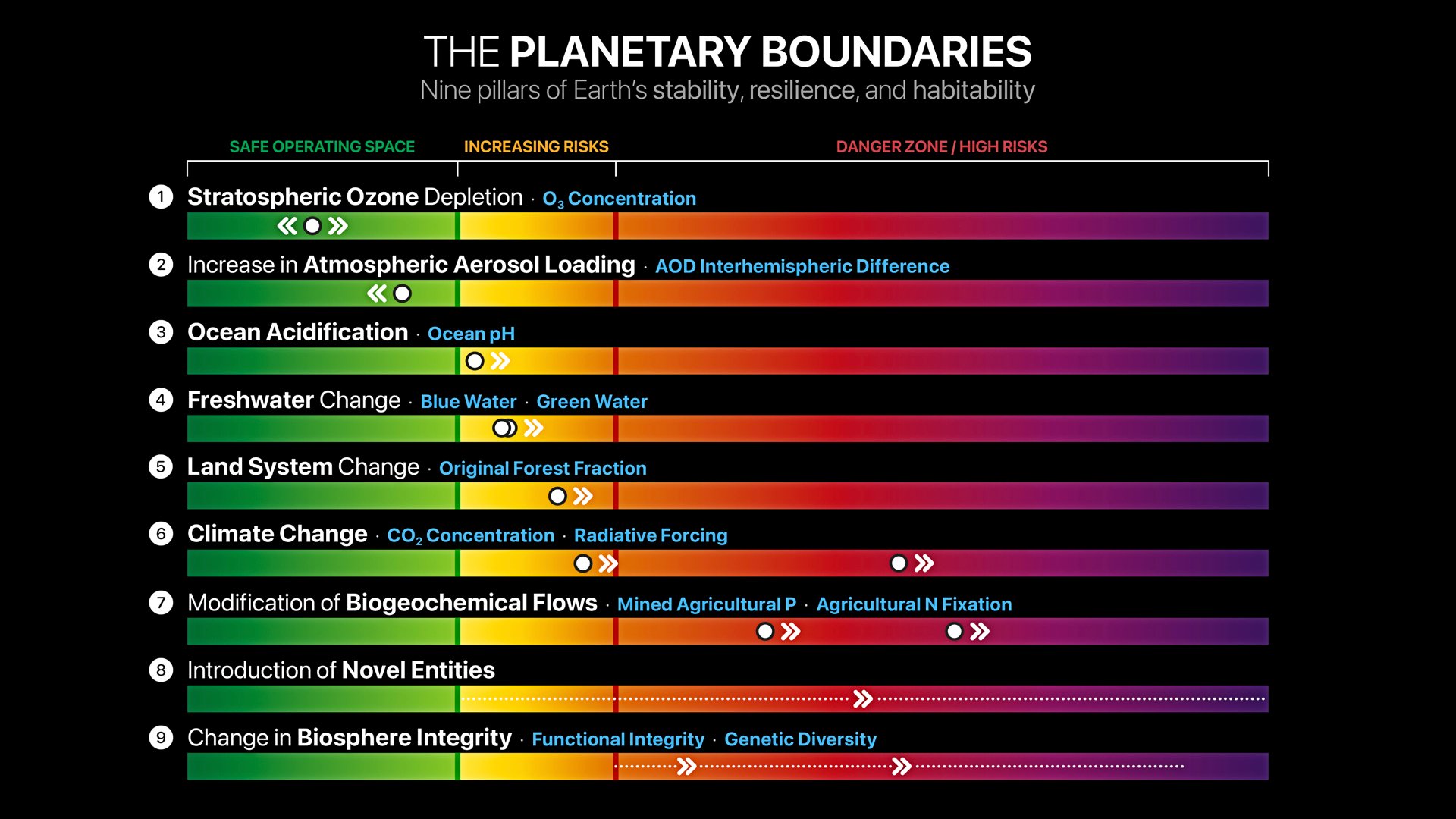
Seven of nine Planetaray Boundaries are transgressed.
Carbon sinks under scrutiny
The assessment also examines the capacity of vegetation and soils to absorb carbon dioxide. Land ecosystems currently absorb a share of human CO₂ emissions, but heat, drought, fire and ecosystem degradation can reduce carbon uptake and, in some cases, turn ecosystems from carbon sinks into carbon sources.
The authors raise the question of whether models used to calculate the land carbon sink may overestimate its resilience.
“Our path to net zero emissions relies on functioning carbon sinks,” Sakschewski said. “Current observations raise the alarm that our planet may be losing its buffering capacity.”
PIK Director and report co-author Johan Rockström said the findings point to the need for action across all nine boundaries.
“We do not have the luxury of time, but we do have the knowledge, capacity and solutions to change course. Accelerating action to return to the safe operating space across all Planetary Boundaries is essential to protect lives and livelihoods, and to deliver on the promise of shared future prosperity,” said Johan Rockström
The Planetary Health Check is published annually to assess changes across the Planetary Boundaries framework and identify shifts in the condition of the Earth system.