A group of leading international scientists has launched an advisory panel for the global energy transition.
The goal of the Science Panel for the Global Energy Transition (SPGET) to provide rapid, authoritative, and policy-relevant scientific input to the international effort to transition away from fossil fuels. This includes country and sector-level milestones for phasing out fossil fuels in line with scenarios that return warming to 1.5°C by the end of the century, and recommendations on policy design for fossil-fuel phase out.
https://www.youtube.com/watch?v=MwmuHGSX8x4
The formation of the Science Panel answers a direct call made during the 2025 United Nations climate conference (COP30) plenary in Belém, where COP President André Aranha Corrêa do Lago urged nations to establish a roadmap for accelerating the transition away from fossil fuels.
"We encourage governments and institutions to draw on the the Panel’s analyses, policy briefs, and country-level engagement to strengthen nationally determined contributions, inform sectoral strategies, and accelerate implementation of just and orderly energy transitions across different national contexts,” André Aranha Corrêa do Lago, COP30 President said. “We hope the Panel’s findings will also enrich multilateral debates and possible deliberations, including under the UNFCCC, and contribute to the broader scientific and policy ecosystem supporting successive rounds of ambition under the Paris Agreement."
The scientific effort has been convened by Johan Rockström of the Potsdam Institute for Climate Impact Research and Carlos Nobre of the University of Sao Paolo. The initiative has secured official support from the Brasilian COP30 Presidency. The Dutch Ministry of Climate Policy and Green Growth and the Colombian Ministry of Environment and Sustainable Development (organisers of the Santa Marta conference) are also supportive.
The panel will be chaired by Vera Songwe, co-chair of the High Level Expert Panel on Climate Finance (Cameroon), Ottmar Edenhofer, director and chief economist of the Potsdam Institute for Climate Impact Research (Germany), and Gilberto M. Jannuzzi, professor of energy systems at Universidade Estadual de Campinas (Brazil).
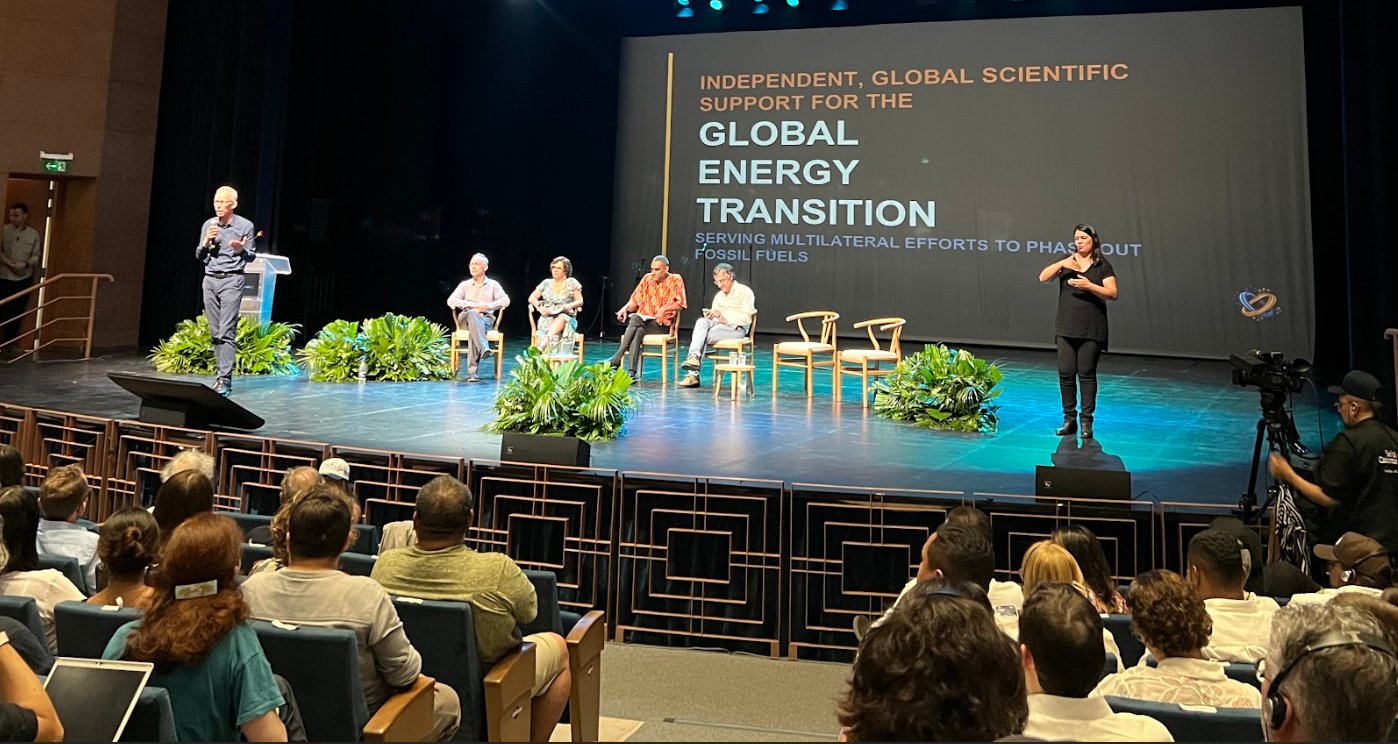
The launch of the Science Panel at Teatro Santa Marta on Friday night, april 24.
The panel was launched alongside a draft roadmap to phase out fossil fuels in Colombia, and a report detailing 12 actionable insights from the Ad hoc Santa Marta synthesis group.
The timing could hardly be better. The current conflicts in Ukraine and the Middle East highlights the significant security, economic and environmental risks of continued dependence on fossil fuels. Every country has the potential to develop a national fossil fuel phase out roadmap, led by independent climate councils or similar bodies, and grounded in collaboration between international expertise, the best available science and local knowledge.
"What matters now is moving beyond headline targets to create credible, policy-relevant roadmaps, enabling a just and effective transition,” Professor Piers Forster, Director of the Priestley Centre for Climate Futures at the University of Leeds and co author of the roadmap, said. “Our draft roadmap of fossil-fuel phase out for Colombia demonstrates a clear pathway to economic and societal benefit. Average annual investment of $10.6 billion drives future net economic benefit, reaching $23 billion per year by 2050."
“The call at COP30 made clear that we need to move faster to phase out fossil fuels. It’s good to see that momentum continue with the Santa Marta conference, where countries are coming together to shape a practical roadmap,” Stientje van Veldhoven, The Netherlands Minister for Climate and Green Growth said. “The latest science—including the most promising policy mixes and financing options — is essential for building those roadmaps. A Science Panel for the Global Energy Transition can help turn complex insights into clear, actionable steps for countries. That’s exactly what we need right now to keep 1.5°C within reach.”
“With emissions yet to peak, another El Niño on the horizon, and the prospect of overshooting the 1.5°C limit coming closer and closer, it has never been more important that leaders demonstrate that sensible, sustained and informed decisions on climate action can make a difference in people’s lives for the better,” Johan Rockström, Director of the Potsdam Institute for Climate Impact Research said. “The evidence base for those decisions needs to be accessible, and that’s exactly what this panel could deliver.”
ABOUT THE SCIENCE PANEL
- The panel will act as a science advisory body to inform the transition away from fossil fuels, identifying implementable pathways at the global, regional, national and sectoral levels consistent with keeping 1.5°C within reach. The panel will aim to:
- Synthesise existing knowledge and generate new insights on annual benchmarks for high ambition energy transition pathways to minimise overshoot and return to 1.5°C within this century.
- Map and develop the most promising policy mixes, financial arrangements, sustainable technology solutions and governance dimensions that can support an accelerated transition to a decarbonised energy system.