Climate love review

24-hour solar is closer than ever

Image of Ember

Ember

Climate love
ο»Ώ
Image of post in post detailed view
ο»Ώ
ο»Ώ
ο»Ώ
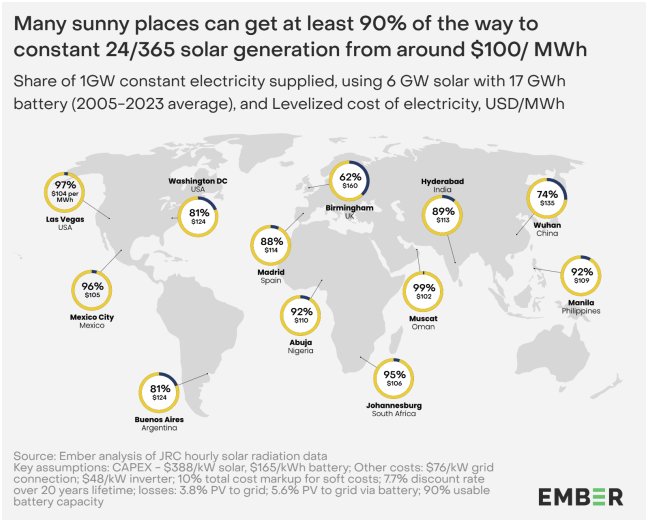
I loved the most recent episode of one of my favorite podcasts, Volts. In it, David Roberts speaks to two researchers from the energy think tank Ember about a fascinating (and exciting!) new paper in which analysts asked, "how much would it cost to produce continuous, grid-scale power using only solar and batteries in different parts of the world?"
ο»Ώ
The results are encouraging enough to surprise even the most bullish solar fans: in very sunny cities, like Las Vegas, Mexico City, and Muscat, solar and batteries could provide power 24 hours a day for less cost than traditional base load generation from coal or nuclear 95%+ of the time.
ο»Ώ
Let me unpack that a bit.
ο»Ώ
Everyone in the climate or energy space has heard that solar is now the cheapest form of generation in most of the world. This is true, but there's a caveat: solar is the cheapest power when the juice is flowing. If the question is merely, "which technology is the cheapest to get 100 kWh of electricity (and it doesn't matter when that electricity is delivered)?" the answer is probably solar.
ο»Ώ
But that's not how people want to get their electricity. Solar by itself is not a "firm" generation technology. It is sunlight dependent, which means it must be paired with storage or another generation technology in order to provide energy on demand. This increases the cost, and that additional cost has made it uneconomical for any large grid to depend primarily on solar.
ο»Ώ
Until now.
ο»Ώ
The plummeting cost of batteries now means that it is possible to build a system based (almost) entirely on solar and battery with 24-hour coverage for less than a system using fossil energy. This is a major milestone in the energy transition!
ο»Ώ
But what's the deal with that "almost"? Well, the problem with weather-dependent technologies, like solar and wind, is that there are occasional weather events that pose challenges. In Las Vegas, for example, there aren't many cloudy days, but there are enough to render our hypothetical solar+battery system insufficient about 3% of the time. This is a problem because even though 3% is not a lot, people are not likely to accept 11 days of blackout per year.
ο»Ώ
Nevertheless, this analysis shows that we are rapidly approaching a world where renewables and storage are viable options for firm, round-the-clock energy services. In the meantime, there is plenty of opportunity for clean generation to start taking up ever larger portions of the grid.

Do you agree?

94 more agrees trigger scaled up advertising

    Follow us

    Β© 2026 We Don't Have Time – All rights reserved.

    We Don’t Have Time is the world’s largest media platform for climate action – with a mission to democratize knowledge about climate solutions and inspire and mobilize global action toward a prosperous, fossil-free future. The content of the We Don't Have Time social network is user-generated. The We Don’t Have Time organization does not automatically endorse users’ opinions and claims. All users of We Don’t Have Time have subscribed to We Don’t Have Time’s Terms of Use, which, among other things, prohibits hateful, abusive, and violent content. If you discover content that violates our Terms of Use, please notify us immediately. The platform is operated by the company WeDontHaveTime AB (publ), whose majority shareholder is the WeDontHaveTime Foundation. The Foundation’s principal purpose is to contribute to a reduced climate impact and an ecologically sustainable environment. Our headquarters is located in Stockholm, Sweden.

    Please read our Privacy Policy and our Cookie Policy.