The news was predictable but no less alarming: 2024 was the hottest year on record. Yet beyond this now-routine climate distress, the world crossed another significant threshold—exceeding 1.5°C of warming above preindustrial levels, a critical boundary designated by the Paris Agreement to avoid the worst impacts of climate change.
This reality sent shock waves through the climate movement. What does it mean? How do we respond?
Convening in front of the Arctic Basecamp expedition tent, We Don’t Have Time, in collaboration with Hitachi Energy, held an expert panel discussion in Davos during the World Economic Forum 2025 to discuss what we can do to prevent a continued rise in temperature. The insights they shared there are worth exploring.
https://www.youtube.com/watch?v=na1pz96gZK8
The Significance of 1.5ºC Warming
“It makes us quite disenchanted as young people because we don’t see progress,” says Mayumi Sato, Early Career Researcher as part of Arctic Basecamp’s youth delegation in Davos.
Mayumi’s frustration is understandable: Despite global commitments, carbon emissions have continued to rise, setting new records almost every year since the Paris Agreement was negotiated in 2015.
Yet current mitigation actions suggest we are on track for more than 3ºC of warming by the end of the century—far beyond the targets needed to prevent the worst impacts of climate change.
The Difference of a Half Degree
“It’s not a promise or a target. It’s actually a physical limit,” says Gail Whiteman, Founder and Executive Director of Arctic Basecamp and Hoffmann Impact Professor for Accelerating Action on Nature and Climate at the University of Exeter. She goes on, “The climate system is complicated but has a number of important tipping elements which will start being triggered from the 1.5ºC physical limit.”
The frequency and severity of storms, heatwaves, droughts, and other consequences of a warmer world do not increase linearly as average temperatures go up. Rather, the rise is exponential. Consequently, the difference between 1.5ºC and 2ºC is severe, particularly for the most vulnerable populations and ecosystems around the world.
In a research presented by the Potsdam Climate Institute, if we stop acting today, we are on track for a 2.7°C increase by 2050, which could result in a staggering $38 trillion in annual GDP losses. This is not theoretical and is already happening as we see costs appearing in supply chain disruptions, extreme weather events and economic instability.
Is It Too Late?
If 2024, in fact, saw 1.5ºC warming, have we not broken the barrier?
The climate is a large and complicated thing. Temperatures do not change uniformly across time and space, even as the global average increases. And that average varies from year to year due to natural anomalies, such as El Niño cycles, and human activities, such as releasing particulate matter into the air.
For that reason, the Intergovernmental Panel on Climate Change (IPCC) focuses on global temperature averaged over a 30-year period. So, one year over 1.5ºC does not mean we’ve missed the target. In fact, scientists believe that both the previously mentioned examples—El Niño and particulate matter—played roles in the unprecedented increases in temperature observed in the past few years.
Despite that caveat, the urgency is clear.
As Gail Whiteman puts it, “It’s not the time to just focus on traditional business. It’s act now.”
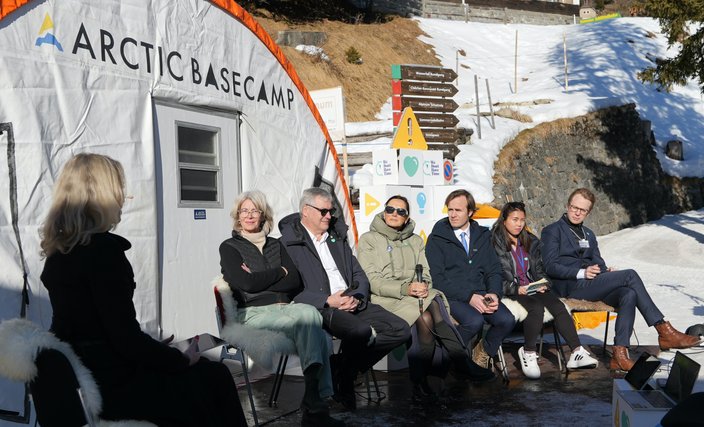
From the left: Moderator Catarina Rolfsdotter-Jansson and panelists Gail Whiteman, Andreas Schierenbeck, Sandrine Dixson-Declève, Andrew Prag, Mayumi Sato, and Ingmar Rentzhog
Staying in the Race
“When I ran my first marathon, I was training hard. I was setting goals but never reaching them,” recounts Andreas Schierenbeck, CEO of Hitachi Energy. “So, what do you do? Give up and stop the race? Or finish the race and start a new effort to continue?”
Surpassing 1.5ºC of warming is a sobering milestone, but it is not the finish line—it is a signal to push forward. The world’s efforts to limit climate change were never about a single threshold but about reducing harm wherever possible. Every fraction of a degree still matters.
As Ingmar Rentzhog, co-founder and CEO of We Don’t Have Time, puts it, “We can’t be unrealistic, optimistic, ignoring the problem, but we can’t be pessimistic saying we are not going to make it either. We need to keep accelerating.”
The path forward requires persistence, adaptation, and a refusal to give in to fatalism. There may be no undoing the warming that has already occurred, but there is still agency in shaping what comes next. As long-distance runners well know, progress is not always linear. What matters most is the determination to keep going.
“It's just becoming now a reality that we must keep ourselves to 1.5ºC,” says Sandrine Dixson-Declève, “and ensure that we don't go too much further.”
Light on the Horizon
Fortunately, technological innovation is providing a legitimate footing for cautious optimism. Everywhere in the world, clean energy is outpacing fossil energy in deployment. And the reasons for that are economic.
This is not only about solving the climate crisis; it’s about building a stronger, more resilient economy.
There are good reasons to believe that this trend will only accelerate. We Mean Business’ Andrew Prag explains, “The energy transition case is really there economically. And now you start to see the positive tipping points. When technology uptake hits a certain level, it really accelerates. And history has shown that, time and again, that change happens slowly and then much faster than people think.”
The rapid growth of clean energy, electric vehicles, and other sustainable technologies demonstrates that progress is possible. Mitigating climate change’s worst effects remains within reach. This does not diminish the urgency of action but rather highlights the need to push harder to maintain momentum and scale solutions quickly.
Hitachi Energy’s Andreas Schierenbeck remains convinced of the solvability of the crisis, “There is light on the horizon. We just have to work together now to find faster solutions.”
Watch the full panel:
https://youtu.be/n1_piL9_kOY?si=gYvPelVROAWmuzkP