A recent expedition exposes how climate change is irrevocably transforming our planet.
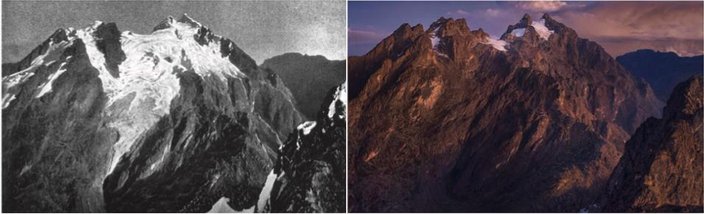
Mt. Stanley in 1906 and now.
Rising majestically from the Great Rift Valley and straddling the border between Uganda and the Democratic Republic of the Congo, the Rwenzori Mountains host an array of ecosystems unlike anywhere else in the world. Early photos of the range show foothills carpeted in dense rainforest, a dramatic ascent through alpine forests and meadows, fields of ice and snow cascading down from the highest peaks.

Dense forests cover the Rwenzori foothills.
Now, climate change is transforming this exceptional landscape.
A recent expedition led by Klaus Thymann for Project Pressure has revealed alarming glacial loss in the Rwenzoris, a UNESCO World Heritage site. The team surveyed the region’s three main peaks—Mt. Stanley, Mt. Baker, and Mt. Speke—using advanced mapping techniques, including drone technology and ground-penetrating radar.
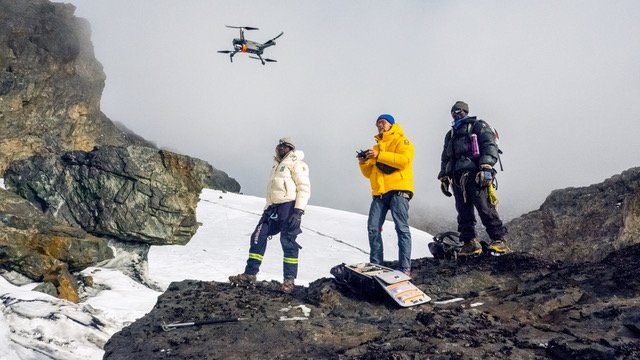
Researchers use a drone to survey Mt. Stanley's glacier.
Findings confirmed that the glaciers on Mt. Baker and Mt. Speke have completely disappeared, while Mt. Stanley’s glaciers are rapidly shrinking. Shockingly, the Stanley Plateau Glacier has lost 29.5% of its surface area since 2020 and is severely fragmenting. This suggests that Rwenzoris will be completely glacier-free within a generation.
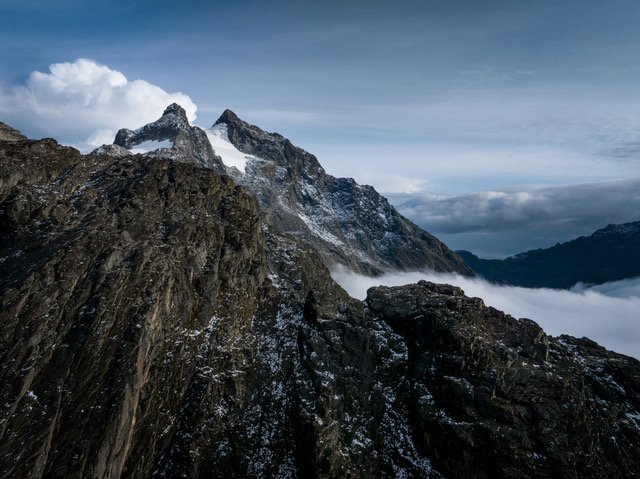
The Rwenzori are thought to be the mythical "Mountains of the Moon," one of the sources of the River Nile.
Constituting one of the sources of the Nile and a resource depended upon by 5 million people in the region, the loss of these glaciers has significant implications for international heritage and local communities. Beyond the environmental impact, the ice loss deeply affects the Bakonzo people of the region, who hold spiritual beliefs tied to the snow-capped peaks that are central to their cultural identity.
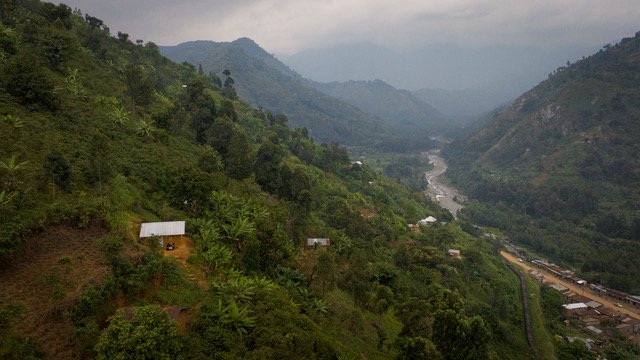
Snowmelt from Rwenzori Mountains is an important water source for local communities.
The expedition, carried out in collaboration with UNESCO and the Uganda Wildlife Authority, created the first-ever 3D model of Mt. Stanley’s glaciers, installed time-lapse cameras for long-term monitoring, and provided training for local communities to support ongoing research. Future efforts will focus on expanding monitoring capabilities and developing mitigation strategies.

Human activities impact even the most remote places.
This critical work underscores the urgent need to study and document locations that are vulnerable to climate change. Equatorial glaciers are among the most vulnerable such places, and their disappearance represents an immediate and striking loss as we enter the era of a warmer world.
A peer-reviewed publication detailing the findings is expected in late 2025.
Visit Project Pressure to learn more.
https://www.project-pressure.org