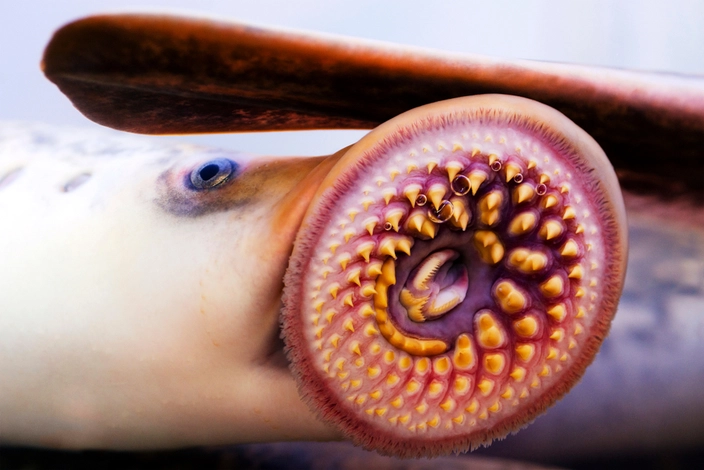
A fish parasite (Lamprea; credit: Gena Melendrez on Shutterstock)
Human activities across the globe are leaving a lot of traces. Some of these traces are caused by meeting basic needs, such as the need for shelter and finding food. But many other traces are caused by social structures that have developed over many years. For example, in my previous article "6 Ways We Need To Change Our Global Economy To Save Our Planet", I explain that the Gross Domestic Product as an economic goal triggers us to focus on economic growth instead of economic health. One of the consequences of focusing on economic growth is resource exploitation and depletion; one of the consequences of lack of focus on environmental health is our linear instead of circular economy. In a linear economy, materials are used and eventually discarded, whereas in a circular economy, no or hardly any resources are wasted because materials are used over and over again. A critical consequence of the linear economy is pollution in the environment. A broad range of pollutants end up in the environment because of our activities, such as chemical pollution. These pollutants include heavy metals such as cadmium, lead, and chrome, nutrients such as nitrate and ammonium, and salts. Other examples are pesticides and pharmaceuticals (further reading: How Pharmaceutical Pollution Harms Aquatic Organisms). They can end up in the environment for example after dumping industrial and domestic waste and wastewater, mining, over-using chemical fertilizers in agriculture, and leaking from landfills. 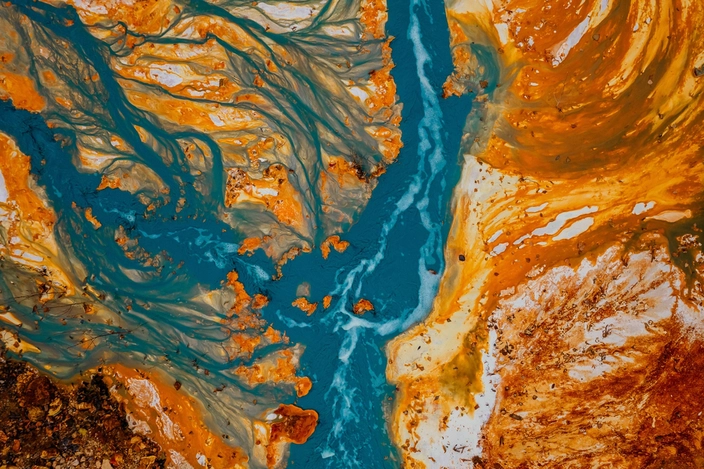
Mining can cause a lot of environmental pollution (credit: Univega on Shutterstock)
Excessive amounts of chemicals and nutrients in the environment due to human activity affect whole ecosystems. An ecosystem is a biological community consisting of organisms that interact with their physical environment. One type of ecosystem is aquatic ecosystems. In aquatic ecosystems, chemicals and nutrients have a large impact on fish and other aquatic animals. For example, nutrients can cause eutrophication of water bodies. Eutrophication means that too much organic matter is produced due to too many nutrients, which reduces the water quality and amount of oxygen in the water so that for example fish die.
Apart from pollutants in the environment, parasites are affecting fish as well. Parasites are organisms that are also part of aquatic ecosystems; they live in or on other organisms (the host) which is often harmful to the host. Parasites can harm the host by extracting nutrients, damaging tissues and organs, triggering the immune system, and affecting the normal functioning of the body. They can also impact fish populations, for example by reducing the number of fish in a population or by making fish unable to reproduce. The presence and number of parasites in aquatic environments depend on several factors, including environmental conditions such as water temperature and the presence of species that do not naturally live in the aquatic environment.
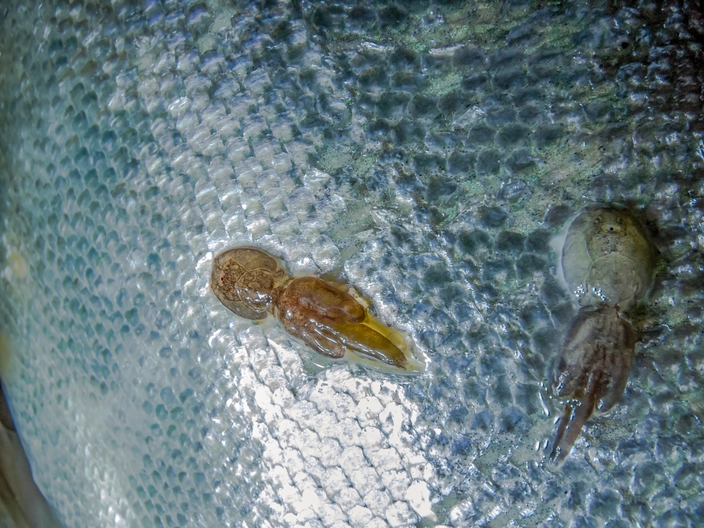
Two parasitic sea lice on a salmon fish (credit: NatureDiver on Shutterstock)
While pollutants and parasites impact fish, pollutants can also directly or indirectly influence the number of parasites. This is how pollutants can increase or decrease the number of parasites:
More parasites
On the one hand, the presence of pollutants can increase the number of parasites. This is because pollutants can cause stress that affects the functioning of fish's bodies and can weaken their immune systems. This stress and the consequences make it more likely that a parasite can thrive.
For example, the pollutant PCB 126 completely suppresses the production of antibodies against the parasite Anguillicola crassus in European eels (Anguilla anguilla). PCB is a toxic, man-made, and dangerous chemical that negatively affects the environment and our health. It is produced as a lubricant and coolant for electrical equipment. Also, when PCB 126 is present together with cadmium pollutants, this causes high cortisol levels in eel blood. Cortisol is a stress hormone. This often increases fish infections with this parasite and allows this parasite to grow in number.
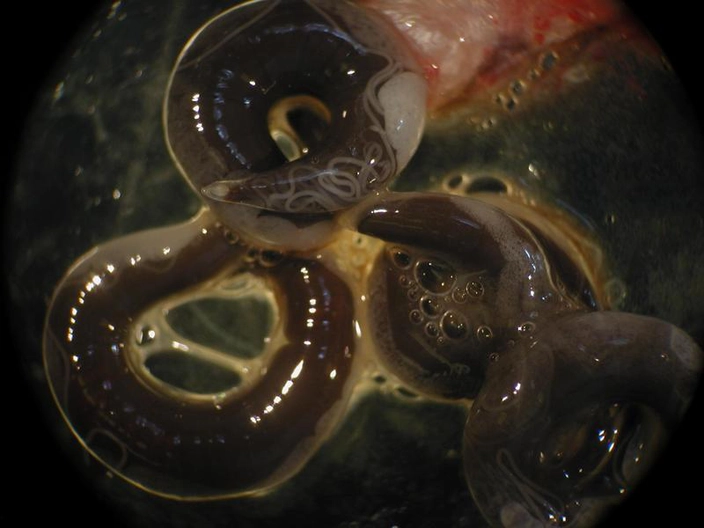
Four Anguillicoloides crassus parasitic worms(credit: "Anguillicola crassus" by Bill.bessmer is licensed under CC BY 3.0)
Also, the presence of pollutants can increase the number of parasites because some parasites reduce the harmful effect of pollutants on fish. Reducing the harmful effect on fish allows these fish to thrive and increases the number of hosts for these parasites.
For example, the harmful effect of PAH is reduced when fish are infected with parasitic worms called acanthocephalans because they reduce oxidative damage. PAH is naturally present in fossil fuels, and forms or binds to small particles in the air after being burned. Oxidative damage is caused by oxidative stress, which is an imbalance between the amount of toxic molecules in cells and tissue and the ability to detoxify these molecules. Also, some freshwater mussels (Pisidium amnicum) can survive twice as long when exposed to the pollutant PCP after they are infected with larvae of certain parasitic flatworms. PCP is a chemical that is used as a pesticide or for disinfection.
Fewer parasites
On the other hand, the presence of pollutants can decrease the number of parasites. This is because pollutants can not only weaken fish, they can also affect fish so much that they die. This is for instance the case with eutrophication, high metal and chemical concentrations, and a high salt level. When fish die or produce fewer offspring, fewer hosts are available for parasites. As a consequence, their number reduces as well. For example, a fire in a chemical production plant in Switzerland in 1986 caused a huge amount of chemicals used in agriculture to end up in the Rhine River. These chemicals killed most of the eels within a short time. As the number of hosts reduced, the number of parasites reduced as well.
Conclusion and how we can take action
So, pollutants impact fish parasites by either increasing or decreasing their numbers. Parasites' numbers can increase when pollutants make fish more vulnerable and when parasites reduce the harmful effect of pollutants on fish. Their numbers are reduced when pollutants are so harmful to fish that the number of hosts is reduced.
As pollution is harmful to fish either directly or by increasing the number of parasites, here are practical ideas of what you and I can do to reduce pollution:
- Disposing of waste properly
- Causing as little waste as possible, for example by only buying products when necessary and buying products without packaging
- Preventing pollution from reaching waterways, for example by growing plants that extract pollutants from water and soil (further reading: chapter 11 of A Guide to a Healthier Planet: "Pollution Solutions: Removing Pollutants from Soil and Water"
Which one of these can you implement in your daily life? And do you have further ideas of what you and I could do? Thank you in advance for putting them into practice and sharing them in a comment to this question to inspire all of us.
---
https://www.sustainabledecisions.eu/guide-to-a-healthier-planet
---
About the author
Dr. Erlijn van Genuchten is a an internationally recognized environmental sustainability expert. She is a science communicator, helping scientists in the fields of nature and sustainability increase the outreach of their results and allowing us all to put scientific insights into practice and contribute to a sustainable future. Erlijn has inspired thousands of people around the world - for example - by supporting the United Nations with her expertise, her book "A Guide to A Healthier Planet" published by Springer Nature, her YouTube channel Xplore Nature, and her posts on social media.
Credit
This article is based on: