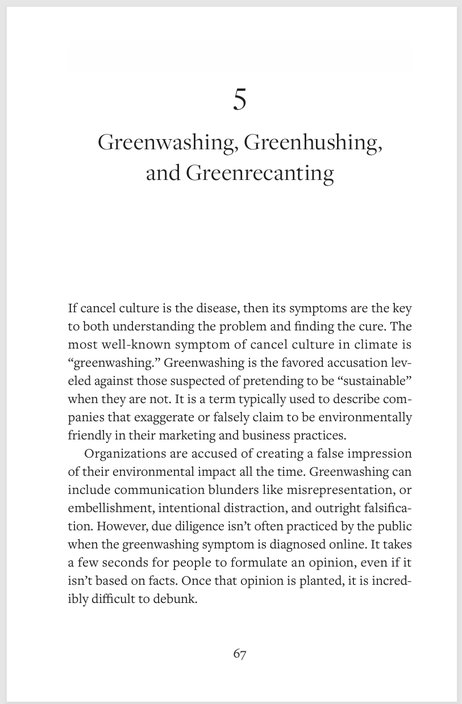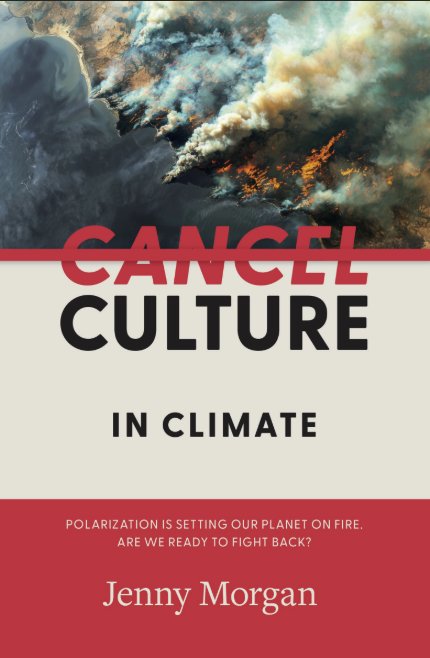
At the end of this interview, you’ll find an exclusive excerpt from Jenny Morgan’s new book, Cancel Culture in Climate. Read the chapter, "Green Greenwashing, Greenhushing, and Greenrecanting", for free!
In 2015, British author and journalist Jon Ronson published the book, “So You’ve Been Publicly Shamed.” In it, he explored the stories of various real people who had experienced internet shaming, a relatively new phenomenon as social media had only recently gone mainstream.
The book turned out to be prescient. Within a few years, the term “cancel culture” had been coined to describe the social tendency online to single out individuals for mass ridicule and condemnation, often for relatively innocuous offenses or regrettable choices made many years before.
While it is true that “cancel culture” could be better understood as “accountability culture” in certain cases, there is no doubt that its net effect has been largely negative: more division, less empathy, more hostility, less openness.
Worst of all, from a political perspective, cancel culture works as a circular firing squad, driven by and directed toward people who broadly agree on the issues. Needless to say, such arrangements are not good for progress making.
While usually associated with disputes over race, gender, and sexuality, cancel culture dynamics are busily at work in the climate space, too, as American author Jenny Morgan explains in her debut book “Cancel Culture in Climate.” She argues that the prevalence of purity testing, dichotomous thinking, and virtue signaling is holding the movement back, leading to more intergroup squabbling than emissions cuts.
We Don’t Have Time spoke with Jenny about her book and how she thinks a spirit of empathy and openness can mobilize more climate action and secure a safer future for everyone.
Can you tell us a bit about your background and how you came to write your book?
I worked in tech, leading a team focused on social impact, and noticed how sustainability and social impact often operated in silos. I was trying to unify these efforts into a cohesive movement centered on impact and equity and, during that time, I began experiencing elements of cancel culture, though I didn’t have the words for it then.
I was also a B Corp consultant and later shifted to working exclusively in climate, while maintaining my B Corp certification agency. In the climate space, I kept seeing polarization: nature-based vs. tech-based solutions, climate activists vs. deniers, policy advocates vs. sustainability leaders. And I started to see it as the primary challenge standing between us and climate security: our inability to communicate and collaborate with one another. I started talking about it, and eventually annoyed my friends and family so much that I decided to write a book.
What similarities or differences do you see between cancel culture in general and in the climate space?
They’re very similar. Both rely on shame and blame, expecting this to create positive change. But instead, it causes division. Unlike legal frameworks, which have flaws but follow set rules, cancel culture has no structure—just a relentless appetite for conflict.
In the climate space, when accusations of greenwashing or greenhushing arise, we often skip the due diligence needed to uncover the truth. For example, if a company claims its chapstick is 30% recyclable and gets accused of greenwashing, we don’t investigate whether it was a communication error or intentional deception. This lack of thoroughness sows chaos in a movement that requires unity and urgency.
How can we promote unity when there are so many differing priorities?
It starts with finding common ground. We all share the same ultimate goal: safety and security for ourselves and our communities. Climate change threatens that, but we interpret our roles in addressing it differently, which leads to division.
If we focus on this shared priority, we can work backward to find solutions that align with safety and security. For example, I’ve seen debates about electric vehicles devolve into arguments that leave everyone feeling lost or ashamed because they might have just purchased a Tesla thinking that they did something positive for the planet, and now they're not sure if they're part of the problem or not. But if we celebrate progress instead of pointing fingers, we build momentum and create a ripple effect.
What are greenwashing, greenhushing, and greenrecanting?
If cancel culture in climate is the illness, the symptoms of that illness are those three things: greenwashing, greenhushing, and greenrecanting.
Greenwashing is falsifying information about your climate impact without defining the intention. Sometimes it happens accidentally because there is miscommunication between marketing and sustainability leaders. And then sometimes people go all out and just completely lie. Volkswagen’s emissions scandal is an example. They put mechanisms in their cars to falsify data, so that is pure greenwashing, like a dictionary version of greenwashing
Greenhushing is going silent. Say someone that has discovered that they haven't been as successful as they had hoped. Their commitments were a bit more aggressive than they were able to achieve. So, rather than being transparent about those obstacles, they bury some of the information so that it's not discovered. They're operating in fear of public scrutiny rather than being curious and looking for other innovators that can potentially support.
There can be different reasons for it, but it’s incredibly dangerous because we're not learning. We're not invigorated by the progress that is actually happening. I think that's actually the most dangerous symptom.
And then greenrecanting, which we're seeing an enormous amount of right now, is those that are simply renouncing their commitments. And, again, intention can be different. They're basically giving up and saying, “we're gonna close this department down completely.”
Where do you see things heading? Is the climate movement going to come around on these issues, or are things going to get worse before they get better?
Both.
Cancel culture in climate has evolved. A year ago, it focused more on internal divisions within the climate community, like competing for funding or pushing one solution over another. Now, I see more unity within the movement, with cancel culture shifting to target external entities.
Right now, there is going to be frustration with lack of policy and regulation, just based on how the world is going politically. But I think we operate on a pendulum. I actually have high hopes that industry will step up to satisfy that gap. There are going to be these setbacks that feel devastating, but if you look at it overall, we're going to be seeing progress. So, I'm optimistic about it.
What’s your message to people concerned about these issues?
Start conversations. So, maybe a company will say, “yeah, we actually didn't meet our targets last year, but it was because this technology didn't come out when we thought it would, but here is our plan to address it.” Look at airlines. Everyone thought that sustainable aviation fuel was going to be what saved everybody, but it's taking longer than anticipated. So, those commitments are being delayed, and you're seeing some airlines coming out and talking about that publicly. Air New Zealand is one example that has done a fantastic job of admitting disappointing setbacks, but providing the reasons why.
Whether it’s a company or someone trying to talk to a family member who doesn’t believe in climate change, sharing struggles can create a ripple effect of "I experience challenges, too!”
Thank you for talking with us.
Thank you!
Read the chapter "Green Greenwashing, Greenhushing, and Greenrecanting" for free in this exclusive excerpt of Jenny Morgan's new book "Cancel Culture in Climate.
Visit the "Cancel Culture in Climate" website where you can order the book here.