Article
The hidden cost of the tail: understanding the environmental impact of contrails

Goodwings
59 w
•
•
Written by Josefine Bovbjerg, for Goodwings
Look up at the sky after an aircraft has passed overhead, and you'll often spot those familiar white streaks trailing behind. They seem harmless enough—but these thin clouds, known as contrails, are one of aviation's most overlooked climate challenges. Short-lived yet powerful, contrails trap heat and may account for between one and two-thirds of aviation’s total warming effect. If aviation is to reduce its climate impact, contrails must be tackled alongside CO₂ emissions.

🟩 Wait - What are contrails?
Contrails are the long, thin clouds that form behind aircraft engines at high altitudes. The name comes from "condensation trails," which perfectly describes what's happening up there. When hot exhaust gases from jet engines mix with the cold air at cruising altitude (typically 8-12 kilometers above ground), water vapor in the exhaust rapidly condenses and freezes around tiny particles in the exhaust stream.
Think of it like your breath on a cold winter morning, but at -40°C and traveling at 900 kilometers per hour. The process creates those distinctive white lines we see from the ground.
Most contrails dissipate within minutes, but under the right atmospheric conditions, they can persist for hours and spread across vast areas of sky. These persistent contrails eventually evolve into cirrus-like clouds that can cover hundreds of square kilometers. What starts as a thin white line behind a single aircraft can transform into a blanket of artificial cloud cover.
Here's the crucial bit: these aren't just visual pollution. They're active players in our planet's energy balance, trapping heat that would otherwise escape to space.
🟩 CO₂ vs. Non-CO₂ Emissions: Understanding the difference
Aviation contributes to climate change in two distinct ways: through CO₂ emissions and through a range of non-CO₂ effects. To understand contrails - a non-CO₂ effect - and their impact on the climate, it’s important to distinguish between the two:
- CO₂ Emissions: Direct greenhouse gases produced when jet fuel burns. CO₂ is long-lived—once emitted, it can stay in the atmosphere for hundreds of years, accumulating and driving ongoing warming.
- Non-CO₂ Effects: These include contrails, nitrogen oxides (NOx), water vapor, and aerosols. Non-CO₂ effects are generally more short-lived but can create significant immediate warming. For aviation, non-CO₂ impacts—especially from contrail cirrus—may account for up to two-thirds of the sector’s climate impact.
In Growing Impact, a podcast by the Penn State Institute of Energy and the Environment, aerospace engineer Sven Schmitz highlights this distinction:
"You can broadly categorize aviation's climate impact into CO₂ and non-CO₂. The primary non-CO₂ effect is this type of artificial cirrus cloud warming. And that's, I think, not really in the public awareness."
Despite CO₂ being the main focus of climate targets—because of its long-lasting impact—it is essential to recognize the role of non-CO₂ emissions. Contrails, the most significant non-CO₂ contributor, form artificial clouds that trap heat far more intensely than CO₂, albeit for shorter periods. In fact, on an annual basis, contrail-induced cirrus are estimated to cause a warming effect comparable to, and in some cases greater than, aviation’s CO₂ emissions, with studies estimating the impact to be between one and two-thirds of aviation’s total warming effect.
The takeaway is clear: tackling both direct CO₂ emissions and indirect non-CO₂ effects is vital if aviation is to make meaningful progress toward climate goals.
🟩 Why contrails matter for the climate
Aviation's climate impact extends far beyond the carbon dioxide pumped out of jet engines. Scientists classify these additional effects as "non-CO₂ impacts" and contrails sit at the center of this complex picture.
When contrails form and persist, they create high-altitude clouds that act like a blanket around Earth. During the day, these clouds reflect some sunlight back to space (a cooling effect), but they also trap infrared radiation trying to escape to space (a warming effect).
The problem? The warming effect typically wins, especially at night when there's no sunlight to reflect.
Research suggests that contrails and the cirrus clouds they form may contribute as much to global warming as all the CO₂ emissions from aviation combined. To put this in perspective: contrails can warm the planet more than the fuel burned to create them.
Aviation accounts for roughly 3.5% of human-induced warming, but non-CO₂ effects—dominated by contrails—make up approximately one-third to two-thirds of this impact. That means contrails alone could be responsible for warming equivalent to over 2% of total human climate forcing.
Despite this, most climate policies and emission reduction targets barely acknowledge contrails exist. The Science Based Targets initiative (SBTi), which guides corporate climate commitments, excludes non-CO₂ effects from aviation targets due to "scientific uncertainties." Meanwhile, IATA (the International Air Transport Association) recommends broadening focus to include non-CO₂ impacts and supports coordinated action for deeper climate progress.
🟩 The science behind the clouds
Contrails aren’t just "hot meets cold," but a complex interaction of atmospheric conditions, aircraft emissions, and aerosol particles.
Contrails form when three key conditions align: low temperatures (typically below -40°C), high humidity, and the presence of condensation nuclei. At cruising altitude, the atmosphere can become supersaturated with water vapor—holding more moisture than it would normally at those temperatures. When jet exhaust introduces additional water vapor and tiny particles (mainly soot from fuel combustion), it triggers rapid condensation and freezing.
The initial contrail formation depends heavily on atmospheric conditions. In dry air, contrails disappear quickly as ice crystals sublimate back into water vapor. But in humid, supersaturated air, contrails can persist and grow, drawing moisture from the surrounding air to form "contrail cirrus."
The type, persistence and impact of contrails vary, depending on the conditions:
- Short-lived contrails vanish within minutes in drier air
- Persistent contrails remain and can evolve into expansive cirrus cloud layers, trapping heat over much longer periods. These artificial cirrus layers - part of what researchers call Aviation Induced Cloudiness (AIC) - can persist for hours or even days
Where and when they matter most:
Contrail-induced cirrus clouds can live for hours or even days, spreading horizontally and vertically through the atmosphere. They trap heat that would otherwise escape into space, with the overall effect influenced by:
- Time of day: Night-time contrails trap heat but don't reflect sunlight, causing more warming impact.
- Altitude: Higher contrails, in colder air, are more effective at trapping heat.
- Geography: Heavily trafficked, mid-latitude routes are prime areas for persistent contrails.
- Season: Winter means more favorable conditions for their formation.
🟩 Aviation’s climate blind spot
Contrails are not just streaks in the sky—they’re one of aviation’s biggest climate blind spots. When we break down aviation’s total warming, CO₂’s effect is centuries long and devastating, but some early studies of non-CO₂ effects show that they might have as big - or even bigger - a warming effect as CO₂, with contrails and the cirrus clouds they create doing most of the damage.
How big is the contrail problem, really?
- Bigger than CO₂ alone: Contrails are estimated to cause warming comparable to, and in some studies greater than, aviation’s cumulative CO₂ impact — equivalent to ~2% of total human climate forcing
- Fast-acting: Their climate impact happens within hours, rarely lasting more than a day, unlike CO₂ which lingers for centuries. That makes them both dangerous and an opportunity - cut contrails, and the warming effect disappears almost instantly
- Concentrated impact: Just 12% of flights cause around 80% of contrail forcing, mostly night and winter flights at specific altitudes
Despite this, contrails remain almost invisible in climate policy. By ignoring them, we underestimate aviation’s true warming effect, often by a factor of two or more.
🟩 What can we do about it?
Contrail mitigation is no longer just theory - trials are already underway. According to IATA’s 2024 report “Aviation Contrails and Their Climate Effect”, action is needed across science, operations, and policy to reduce non-CO₂ impacts. The roadmap highlights steps being taken now, and those needed in the near, mid, and long term.
An overview of IATA’s roadmap to reduce non-CO₂ impacts:
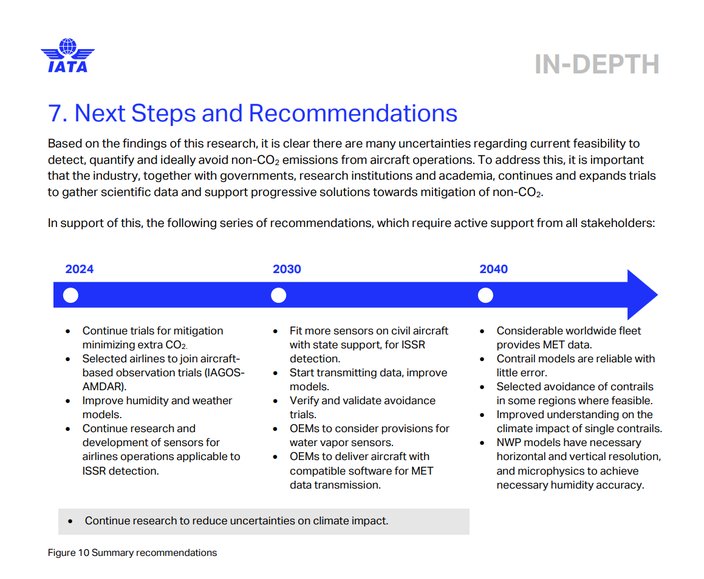
https://www.iata.org/contentassets/726b8a2559ad48fe9decb6f2534549a6/aviation-contrails-climate-impact-report.pdf?
What’s happening now (2024–2030)
- Cut CO₂ where possible: Reducing overall emissions remains the priority while contrail science develops.
- Gather better data: Airlines are equipping aircraft with humidity and particle sensors (programs like IAGOS, AMDAR, and flight trials with United, Delta, and Lufthansa are examples).
- Smarter forecasts: AI-powered weather and contrail prediction tools are being tested with Google Cloud, SATAVIA, and others.
- Targeted avoidance: Small reroutings on a few high-impact flights—responsible for most contrail warming—are already being trialed.
Scaling up (2030–2040)
- Standardize monitoring: Create global systems for reporting contrail-relevant data.
- Improve accuracy: Continuous validation of models with real flight data.
- New aircraft designs: Build in meteorological sensors and contrail-avoidance tools from the ground up.
Long-term vision (2040–2050)
- Global sensor networks: A large share of aircraft feeding real-time atmospheric data into climate models.
- Integrated weather systems: High-resolution, global forecasts guiding daily operations.
- Future fuels: Deeper understanding of SAF and hydrogen’s non-CO₂ impacts.
- Routine contrail avoidance: Avoiding contrail-forming regions becomes a standard part of flying.
Other organizations echo and expand these recommendations. The Clean Air Task Force is emphasizing the need to include contrail mitigation, and calling for a multi-pronged approach to aviation’s climate footprint, complementing CO₂ reductions for faster action. The FAA, NASA, and NOAA (2023) jointly released a Contrails Research Roadmap, calling for coordinated U.S. efforts in satellite detection, in-flight sensors, and integration with air traffic management. Meanwhile, the EU will require airlines to report non-CO₂ effects and fuel composition from 2025, ensuring greater transparency.
🟩 The Role of Sustainable Aviation Fuels and Hydrogen
How Can Sustainable Aviation Fuels (SAF) Help Reduce Contrails?
Sustainable Aviation Fuels (SAF) are often promoted as a cornerstone of aviation’s climate strategy because they cut lifecycle CO₂ emissions. But SAF may also influence non-CO₂ effects, especially contrail formation.
What we know: SAF and contrails
still evolving, but several key findings stand out:
- 50–70% fewer soot particles: Flight tests show that using SAF blends can cut non-volatile particulate matter (nvPM) emissions by more than half, reducing the number of ice crystals that seed contrails.
- Thinner, shorter-lived contrails: With fewer particles, ice crystals tend to be larger and fall out of the sky faster, potentially reducing contrail persistence and warming impact.
- 100% SAF could reduce warming by ~44%: Modeling suggests a complete switch to SAF might increase contrail occurrence slightly (+5%) but reduce their overall radiative forcing nearly by half.
Contrails form when water vapor condenses and freezes around soot particles emitted from jet exhaust. Conventional fossil jet fuel produces a high number of soot particles, which act as condensation nuclei. SAF typically contains fewer aromatics (particularly naphthalene) and sulfur compounds, which means fewer soot particles are emitted during combustion. Laboratory and flight tests suggest this reduces ice nucleation sites and can lead to thinner, shorter-lived contrails.
SAF clearly reduces soot emissions and alters contrail properties, but the net climate benefit is not yet fully quantified. Contrail behavior depends heavily on atmospheric conditions, meaning SAF alone cannot “solve” contrails—it must be combined with operational and technological strategies to maximize its climate impact.
Will Hydrogen powered flights be the end of contrails?
Hydrogen-powered aircraft are often presented as a long-term climate solution for aviation—but when it comes to contrails, the story is more complex. Burning hydrogen produces no soot particles, which are the main seeds for ice crystal formation in contrails. This means hydrogen contrails would contain fewer but larger ice crystals, which fall out of the atmosphere more quickly and may reduce their warming effect.
However, hydrogen combustion generates about 4–5 times more water vapor than kerosene, increasing the likelihood of contrail formation in the first place. The result is a potential trade-off: contrails may form more often, but they are expected to be shorter-lived and less climatically **harmful** than today’s kerosene-based contrails.
Early modeling suggests that liquid hydrogen aircraft could reduce contrail radiative forcing by up to ~25% compared to conventional jets, but these findings still remain highly uncertain, as large-scale hydrogen flight data does not yet exist. Programs like Airbus and DLR’s Blue Condor experiment—which is flying hydrogen-fueled test aircraft specifically to study contrails—are beginning to provide the first real-world insights.
The bottom line: hydrogen powered flights won’t eliminate contrails, but they may make them less damaging. More research, flight trials, and atmospheric measurements will be needed to understand their true climate impact.
🟩 How are we measuring and reporting on the effect of contrails?
Measuring the climate impact of contrails isn’t straightforward. Unlike CO₂, which accumulates in the atmosphere for centuries and is relatively easy to track, contrails are short-lived and highly variable. Scientists therefore use a mix of methods to understand their contribution to aviation’s warming effect.
Radiative Forcing Index (RFI)
Historically, one of the first tools was the Radiative Forcing Index (RFI), which compares aviation’s total warming impact (CO₂ + non-CO₂ effects) to its CO₂-only impact. For example, in 2018 aviation’s CO₂ forcing was estimated at about 34 mW/m², while the total effect—including contrails and other non-CO₂ impacts—was around 100 mW/m². That gives an RFI of roughly 3, showing that planes can warm the planet three times more than their carbon footprint suggests (Lee et al., 2021).
Effective Radiative Forcing (ERF)
More recently, the IPCC has shifted towards Effective Radiative Forcing (ERF). This method accounts not only for the direct warming from emissions and contrails, but also for how they interact with clouds and atmospheric chemistry. ERF is now considered the most accurate way to capture contrails’ role in aviation’s overall climate footprint (IPCC AR6 WGIII, 2022).
Time-based Metrics (GWP & GTP)
To compare short-lived contrails with long-lived CO₂, researchers also use time-based metrics:
- Global Warming Potential (GWP) measures how much warming an effect causes over a set time (e.g., 20 or 100 years).
- Global Temperature-change Potential (GTP) looks at the expected temperature impact at a specific point in the future.
These help policymakers balance the immediate but temporary impact of contrails against the long-term persistence of CO₂.
🟩 Why this matters
Together, these approaches show that contrails and contrail-induced cirrus clouds are the single largest non-CO₂ contributor to aviation’s warming—making up an estimated one-third of its total climate impact. Yet most international climate targets, including those from the Science Based Targets initiative (SBTi), still exclude them due to scientific uncertainty and the difficulty of measuring their effects consistently (SBTi, 2021; Lee et al., 2021; IPCC AR6, 2022).
The bottom line: while we now have multiple ways to measure contrails, they all point in the same direction—contrails are not just streaks in the sky, but a powerful multiplier of aviation’s climate impact.
🟩 Direct vs. Indirect Emissions: Scopes 1, 2, and 3
To understand aviation’s climate impact, it’s useful to break emissions into three categories defined by the Greenhouse Gas Protocol.
- Scope 1: Direct emissions
These are produced directly by burning jet fuel in aircraft engines—CO₂, NOx, water vapor, particles, and contrails. While contrails belong in scope 1, and are one of aviation’s biggest climate effects, they are usually excluded from Scope 1 reporting because methods to measure them are still evolving.
- Scope 2: Indirect energy emissions
Emissions from purchased electricity used in ground operations, offices, or airport facilities. For airlines, these are relatively small.
- Scope 3: Value chain emissions
Everything else—such as the extraction and refining of jet fuel, the manufacturing of aircraft, and the emissions from business travel purchased by companies. For many organizations, Scope 3 makes up the largest share of aviation-related emissions. Contrails from business flights technically fall here too, though they are rarely included today.
Why it matters
Direct CO₂ emissions are only part of aviation’s footprint. Contrails highlight the gap: they clearly belong to Scope 1 (or Scope 3 for air travel customers) but are mostly absent from climate targets, leaving out a major part of the sector’s warming impact.
🟩 Clear skies ahead?
Addressing contrails is an essential—though complex—piece of aviation’s climate challenge. Scientific understanding and technological tools are rapidly evolving, with strong support from industry and regulators. Effective mitigation will rely on coordinated action, targeted policies, ongoing research, and broad adoption of advanced sensors and sustainable fuels.
Ultimately, contrails are a hidden yet powerful factor in aviation's climate story. Integrating non-CO₂ effects into climate targets and leveraging both near-term solutions (better routing, clean fuels) and longer-term innovation (hydrogen, global sensor networks) is required for aviation to meet global climate goals.
The white lines in the sky may be invisible in carbon reports—but not in the atmosphere.
Sources:
Non-CO2 Climate Impacts of Aviation: Contrails, by Clean Air Task Force 2023
https://cdn.catf.us/wp-content/uploads/2023/10/18100300/contrails-brief.pdf
Aviation contrails and their climate effect: Tackling uncertainties and enabling solutions, 30 April 2024, IATA
https://www.iata.org/contentassets/726b8a2559ad48fe9decb6f2534549a6/aviation-contrails-climate-impact-report.pdf
Global aviation contrail climate effects from 2019 to 2021, Published by Copernicus Publications on behalf of the European Geosciences Union
https://acp.copernicus.org/articles/24/6071/2024/acp-24-6071-2024.pdf
Contrails Research Roadmap**, By the Federal Aviation Administration (FAA), National Aeronautics and Space Administration (NASA) and National Oceanic and Atmospheric Administration (NOAA)
https://www.faa.gov/about/office_org/headquarters_offices/apl/contrails/contrails_research_roadmap.pdf
https://pubs.acs.org/doi/10.1021/acs.est.9b05608
Science Based Targets initiative (SBTi) Aviation Guidance (2021)
https://sciencebasedtargets.org/resources/files/SBTi_AviationGuidanceAug2021.pdf
https://www.ipcc.ch/report/ar6/wg3/
https://www.airbus.com/en/newsroom/stories/2025-04-how-to-mitigate-contrails-and-other-non-co2-emissions
[IPCC AR6 Working Group I Report (2021)](
https://www.ipcc.ch/report/ar6/wg1/
[Teoh et al., 2020, *Environmental Science & Technology*](
https://pubs.acs.org/doi/10.1021/acs.est.9b05608
[Growing Impact Podcast, Penn State Institute of Energy and the Environment, Episode with Sven Schmitz](
https://iee.psu.edu/news/podcast/growing-impact-contrails-and-climate-change
https://www.catf.us/2025/03/beyond-carbon-dioxide-aviation-needs-multi-pronged-strategy-address-contrails-reduce-climate-impacts/
https://climate.ec.europa.eu/eu-action/transport-decarbonisation/reducing-emissions-aviation_en

Science needs you
Support Make Science Great Again
Get the exclusive cap crafted from 100% recycled cotton and polyester

With your help, we can solve the climate crisis together. We connect you with people, businesses and organizations that needs your comment to improve for the climate. Read more
© 2026 We Don't Have Time – All rights reserved.
We Don’t Have Time is the world’s largest media platform for climate action – with a mission to democratize knowledge about climate solutions and inspire and mobilize global action toward a prosperous, fossil-free future.
The content of the We Don't Have Time social network is user-generated. The We Don’t Have Time organization
does not automatically endorse users’ opinions and claims. All users of We Don’t Have
Time have subscribed to We Don’t Have Time’s Terms of Use, which, among other things, prohibits hateful,
abusive, and violent content. If you discover content that violates our Terms of Use, please notify us
immediately. The platform is operated by the company WeDontHaveTime AB (publ), whose majority shareholder is the WeDontHaveTime Foundation. The Foundation’s principal purpose is to contribute to a reduced climate impact and an ecologically sustainable environment. Our headquarters is located in Stockholm, Sweden.
Please read our Privacy Policy and our Cookie Policy.