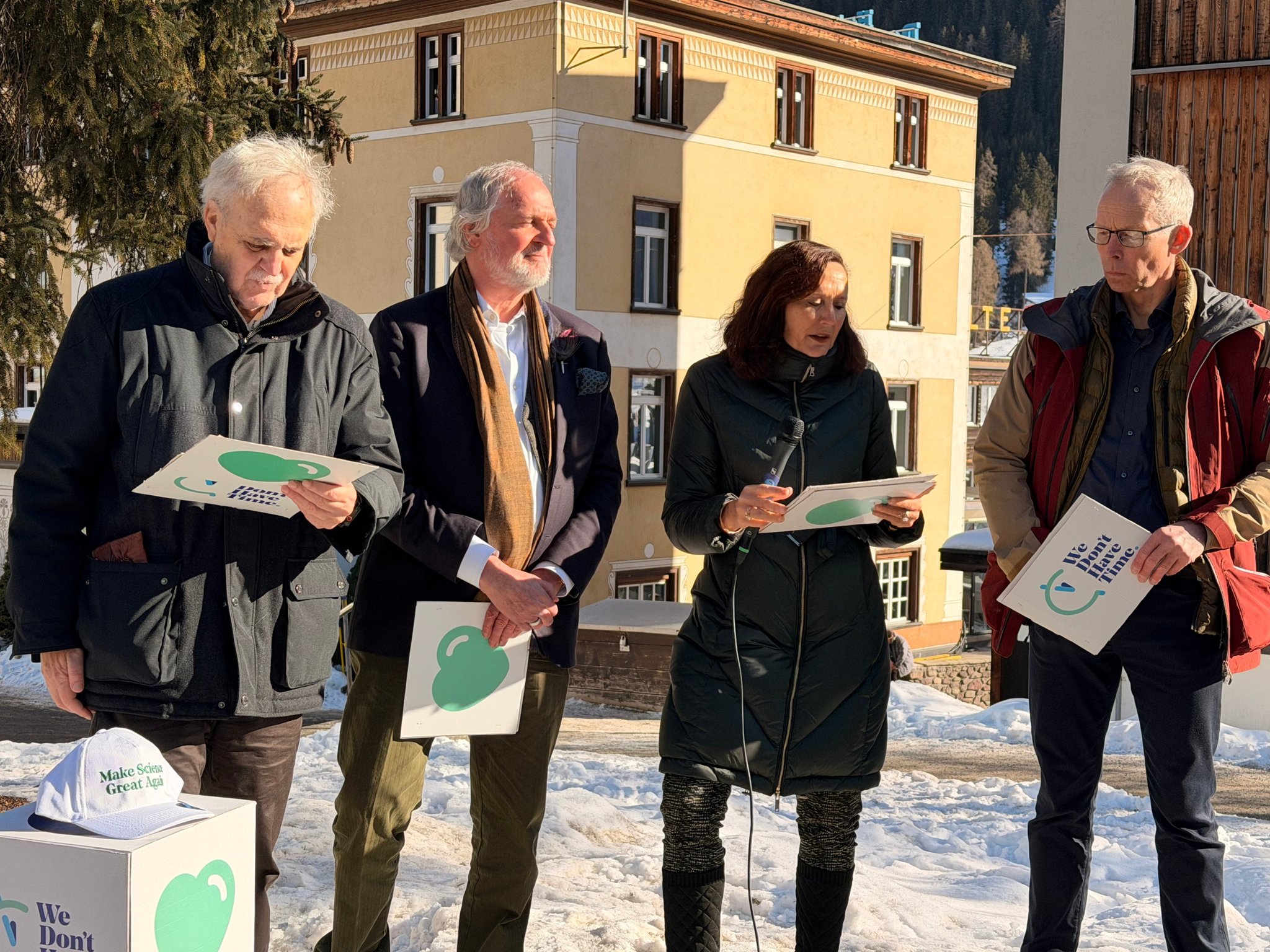
Today in Davos, a group of globally respected leaders, shaping the future of people, planet and prosperity, set out a bold alternative to President Donald Trump’s growth‑at‑all‑costs/America First vision of prosperity, which is grounded in fossil-fuel-driven expansion and deregulation.
https://www.youtube.com/watch?v=Ncysi_d-cy4&feature=youtu.be
With:
Sandrine Dixson-Declève, Honorary President, The Club of Rome & Executive Chair, Earth4All
Johan Rockström, Director Potsdam Institute for Climate Impact Research PIK
Paul Polman, former CEO of Unilever, Planetary Guardian
Carlos A. Nobre, Co-Chair, Science Panel for the Amazon
Hindou Oumarou Ibrahim, Coordinator of the Association of Peul Women and Autochthonous Peoples of Chad, Planetary Guardian
Full transcript of the speech:
[00:00.6]
Good afternoon ladies and gentlemen. My name is Sandrine Dixson-Declève. I'm the former co-president of the Club of Rome and the executive chair of Earth for All. And I'm joined here by my colleagues Johann Rokström, Carlos Nobre and Paul Polman.
[00:16.0]
And we are here today to present a vision of prosperity that is grounded in well-being for a safe planet. We present this vision as a counter-narrative to the vision of prosperity that President Trump will present here in Davos today.
[00:34.8]
His vision is grounded in a fossil fuel-driven expansion and deregulation. It hoards prosperity for the few and is contributing to a world that is less safe and less stable for the majority. That is not our vision and that is not what we will present to you today. I.
[00:54.2]
I will speak first to the theme of the importance of planetary stewardship for economies and all societies. We stand here at a turning point for humanity and the planet.
[01:10.5]
In one lifetime, we have become powerful enough to alter the Earth's system, including our climate, nature, oceans and the web of life that sustains us. At the same time, inequality and social tension are rising and democracy is backsliding everywhere.
[01:34.8]
Every year the damage from climate and nature continue to draw trillions from the global economy. Money that could instead lift millions out of poverty and build a safer and fairer world.
[01:53.1]
As world leaders gather here in Davos, we face a fundamental question about the type of future that we all want. Earth, for all, describes these two possible paths as too little too late, which is today's business as usual and I would say business as usual on steroids.
[02:15.0]
And instead, how can we get to a giant leap that truly brings prosperity within the planetary boundaries?
[02:27.7]
The too little too late clings to an extractive fuel-driven model. It concentrates wealth at the top, leaves billions behind and drives our planet deeper into crisis.
[02:45.7]
And yet we have solid evidence base that investing just 1 to 2% of global GDP in climate and nature restoration could yield 10 times that value in economic and social returns.
[03:03.0]
The Giant Leap this scenario and so many others that offer hope points to a new direction. One building on well being, fairness and care for the only home that we have.
[03:18.8]
It redefines prosperity and regards a stable planet as our only choice for survival, but also as a lasting opportunity for security and for peace and for prosperity for all.
[03:36.8]
More countries today are putting well being and ecological resilience at the heart of their economies. And we know what works. I will now pass the microphone to my colleague, Johan Rockström. This choice of a future which is a dead End or a future that can provide prosperity and equity matters because the science is today unequivocal.
[04:02.1]
We are today at risk of destabilizing the entire planet. Human activity currently is pushing the planet's vital support systems towards dangerous instability across all functions that matter for the global economy. Climate, nature, land, fresh water, oceans.
[04:20.7]
In some places, we're coming very close to no return. Tipping points from melting ice sheets, dying coral reef systems, to the Amazon rainforest could be triggered when we breach 1.5 degrees Celsius, which we're very likely to do within the next five years.
[04:38.7]
These changes will unlock, if we push ourselves to that point, to irreversible damage. Rising seas, collapsing ecosystems, escalating disasters that expose people across the entire world to everywhere to profound risk, which will go in many cases beyond adaptation.
[04:57.4]
The economic costs would be staggering. Coastal cities lost, health systems overwhelmed, entire sectors destabilized. But there is still a window which is open. The chances here if we act now to bring human activity back within the safe and in just operating space of, planetary boundaries of a stable and resilient planet.
[05:23.1]
This requires rapid transformation of our energy, food, transport and industrial systems, starting with the full-scale phase-out of fossil fuels now to a zero carbon economy within the next 25 years. Without it, restoring a stable Earth system is physically impossible.
[05:43.2]
Expanding fossil fuels is a dead end. It's not a path to prosperity, it's a path towards planetary collapse. It would lock in higher emissions and cascading economic losses. The leaders gathered here in Davos have both the power and the responsibility to change course and to lead the transformation that the world so urgently needs.
[06:07.5]
I will now pass on to Paul Polman, business leader, philanthropist and former CEO of Unilever. Thank you, Johan. Many still assume that protecting nature comes at the expense of economic growth.
[06:23.7]
That destruction and extraction are, simply the price we have to pay for capitalism and that safeguarding ecosystems is therefore bad for business. This belief is widespread. And yes, this belief is wrong.
[06:41.6]
Nature is not separate from the economy. It sits at its heart. It determines whether business can operate at all, whether supply chains hold, whether communities are stable, and whether growth can be sustained over time.
[07:00.3]
Factories and data centers depend on clean water and reliable energy. Farming depends on healthy soils, pollinating insects and fresh water. Manufacturing depends on forests, minerals and rivers that can recover.
[07:19.4]
And sectors like insurance, logistics, retail and finance all depend on a world stable enough to plan for the future. When debt stability breaks down, the impacts are not abstract.
[07:36.7]
They show up as higher prices, broken supply chains, lost livelihoods, bankrupt companies and people forced to leave their homes at a time of uncertainty. The instinct for many is often to retreat.
[07:54.8]
But when it comes to nature protection, retreat is the riskiest choice that business can make. Net positive leadership means choosing to strengthen, not to exhaust the foundations of prosperity.
[08:11.7]
Leaders must stop assuming that somebody else will fix their problems and start building growth that restores resilience and ensures the well being of all on this wonderful planet. And now let me pass on to Carlo Nobre, the Earth, System scientist and planetary guardian.
[08:34.1]
Thank you. The planetary emergency is also a justice crisis. Those least responsible for ecological breakdown are being hit first and hardest, facing crop failure, displacement, deadly heat and rising poverty.
[08:56.4]
Indigenous and marginalized communities are on the front lines. Prosperity still eludes the majority, while extreme wealth is concentrated at the top. This is not an accident. It's the result of a flawed economic model and a, misguided notion of prosperity.
[09:18.5]
Planetary stewardship needs everyone around the table. Governments, business, cities and communities, households and individuals. The decisions that we take about food, water, land and resource shape the conditions for life on Earth.
[09:36.8]
A new model of prosperity must do more than redistribute wealth and other resources. It must redistribute power so those who have been pushed to the margins have a seat at the table where decisions are made.
[09:55.4]
The new model of prosperity must do more than redistribute wealth and other resources. It must redistribute power to those who have been pushed to the margin. Have a seat at, the table where decisions are made.
[10:13.0]
The new model of prosperity will also require a shift in international cooperation. The Earth Life Support System do not recognize borders, market or outdated ideas of sovereignty.
[10:29.0]
International cooperation was designed to manage relations between states. But today it must rise to a largest task. Safeguarding an interconnected planet and ensuring a safe and justice space for all people.
[10:48.3]
That is why we call on leaders here in Davos to champion prosperities rooted in human dignity, equity and ecological resilience, anchored in a new model of international cooperation.
[11:05.0]
Earth for All, Potsdam Institute, Earth Commission and who am I forgetting? Global Commons alliance thank you.